



 Print
PrintThe reality of self-defense law
I am not a lawyer, but I’ve enforced, applied, studied and taught the law for a half century. In my role as head of a church security team I still teach the law of self-defense, and have corresponded with Andrew Branca, who is a lawyer, arguably America’s foremost authority on self-defense law, and the author of The Law of Self-Defense: The Indispensable Guide for the Armed Citizen. If you own guns, and particularly if you carry a handgun, it’s a truly indispensable book.
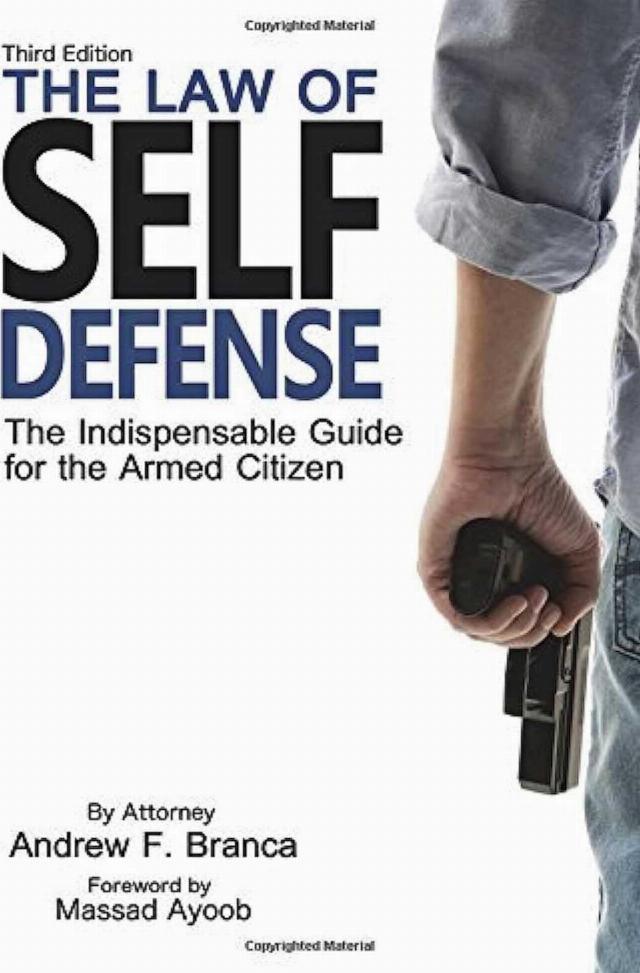
Graphic: Book cover scan
Understand I’m not dispensing legal advice, merely providing general information. It’s vital you read and understand the law wherever you live and travel. It’s equally essential you understand the politics of police and prosecutors wherever you live or travel. Blue states are likely to ignore the law and prosecute the law-abiding for daring to defend their lives against favored criminal victim groups.
The essential fact I’ve learned about the law of self-defense, which comes from the English common law, and before that the Bible, is one can’t review it often enough. It is at once simple and complex.
In essence, deadly force is lawful if a reasonable person would believe they’re facing an imminent threat of serious bodily injury or death to self or another.
If those elements are present, one need not wait to absorb the first blow, gunshot or knife thrust.
Think of “a reasonable person” as a person of average or normal intelligence and perception, Joe or Jane Average.
An “imminent threat” is one fractions of a second or seconds from happening or happening right now. A possible threat, or a threat that might happen in the future does not qualify.
“Serious bodily injury or death” should be self-explanatory, but as I earlier noted, can be tricky.
If someone is standing five feet from you, menacing you with a gun or knife, a reasonable person would believe the threat is imminent and could result in serious bodily injury or death. But what if they’re unarmed but equally aggressive and ready to attack?
Size, weight, numbers and age disparities matter. Human beings are at once amazingly resilient and terribly fragile. I’ve seen people who walked away with barely a scratch from car accidents that looked like their vehicle went through a car crusher. I’ve also seen people who were crippled or killed by a single blow to the head.
A fit 70-year-old man facing a 20-year-old thug, or several thugs even though they’re unarmed, could easily be justified in responding with gunfire. So too could a woman. The average unarmed man could easily kill the average woman, so great is the disparity in strength and aggression.
In the Michael Brown case a police officer was ruled justified in shooting Brown by the local prosecutor and the Obama DOJ because the disparity in size, weight and aggression was so great. Brown was an 18-year-old pot addict and thug wannabe, 6’4” and nearly 300 pounds. He tried to beat the officer to death and nearly succeeded in snatching his handgun. The officer testified it was like trying to fight Hulk Hogan, and the grand jury, and federal prosecutors who would have loved to have jailed the white officer for life, had no choice but to clear him.
If you’re justified in shooting, you may fire as many shots as necessary to stop, not kill the attacker. That’s not merely semantics. If you’re justified in shooting, you shoot because of the overwhelming need to stop the attacker from doing what gave you the justification to shoot in the first place. If they die, that was their very bad choice. And when the threat ends, the shooting ends. Going beyond that might encourage a prosecutor to prosecute you. You do not think, or ever say, you intended to shoot to kill. You don’t want to hurt anyone, but if you didn’t shoot your attacker at that moment, you or another would surely have suffered serious bodily injury or death.
What if an attacker confronts you as you get out of your car at home? You’re justified in shooting, but should you drag them into your home? Absolutely not. If the elements are present, the location is essentially irrelevant. Worse, doing anything to alter a crime scene will surely see you prosecuted.
Again, knowing the law where you live or travel is essential. The majority of states have Castle Doctrine and Stand Your Ground laws, which also may have a bearing on self-defense situations, but that’s a topic for another article.
Become a subscriber and get our weekly, Friday newsletter with unique content from our editors. These essays alone are worth the cost of the subscription.
Mike McDaniel is a USAF veteran, classically trained musician, Japanese and European fencer, life-long athlete, firearm instructor, retired police officer and high school and college English teacher. He is a published author and blogger. His home blog is Stately McDaniel Manor.
FOLLOW US ON


