



 Print
PrintWoke ideology splits the Anglican Church
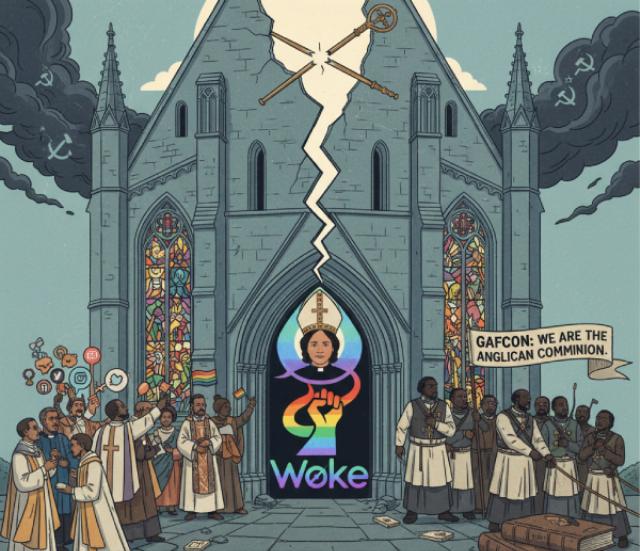
The global Anglican Communion is cracking under the strain of cultural war. What began as the embrace of progressive social agendas in the heart of the Church of England has prompted the conservative provinces in Africa and the Global South to declare a break.
The trigger? The appointment of Sarah Mullally as Archbishop of Canterbury as the first woman in that role. She is described as a “pro-choice feminist” and a supporter of LGBT inclusion.
The creeping influence of left-wing ideology has collided with long-held biblical and historic Anglican traditions.
Archbishop Laurent Mbanda of Rwanda, who chairs the primary governing and leadership body of the conservative GAFCON (Global Anglican Future Conference), issued a statement saying that the appointment “abandons global Anglicans” and shows that the Church of England “has relinquished its authority to lead.”
“We reject the so-called Instruments of Communion, namely the Archbishop of Canterbury, the Lambeth Conference, the Anglican Consultative Council (ACC), and the Primates Meeting, which have failed to uphold the doctrine and discipline of the Anglican Communion. … Today, Gafcon is leading the Global Anglican Communion. … As has been the case from the very beginning, we have not left the Anglican Communion; we are the Anglican Communion.”
The statement demonstrates how deep the split has become. This is not a disagreement over liturgical style, but a battle over the authority of Scripture and the nature of the church. The African bishops maintain that the historic teaching of the church — male headship in the episcopacy, historical definitions of marriage as between one man and one woman, the authority of Scripture over cultural accommodation — are not optional, but foundational.
The Church of England’s drift into “woke” cultural projects and its embrace of identity agendas signal that it no longer upholds that foundation. Recently, the Cathedral in Canterbury commissioned a graffiti art installation focused on “marginalised” communities and micro-agendas of identity, rather than traditional forms of worship or doctrine, Front Page Magazine reports.
Leftism in the church treats theology as another front for cultural politics rather than stewardship of historic Christian faith. As a result, institutions rooted in Scripture and tradition feel compelled to choose sides. Many African provinces see the Church of England’s orientation not as “progressive reform” but as theological apostasy.
Conservative Anglicans in Africa are not simply resisting change for the sake of it. They are defending what the Bible teaches. Paul’s letters, the pastoral epistles, the councils of the early church all make clear that church leadership and doctrine have boundaries. And so the African bishops do not merely dissent; they declare themselves the true voice of Anglicanism.
The same cultural currents that have roiled mainline Protestantism in the U.S. are now being played out on a global scale in Anglicanism.
The conservative bishops are not simply nostalgic; they are holding on to teaching that is centuries old, grounded in Scripture, and consistent with historic Anglicanism.
Leftism within Christianity is not new, but these recent moves embrace the idea of “church” as rooted in divine revelation rather than human ideology. The Anglican Communion’s fracture is a warning against the gospel becoming a social project and culture becoming the arbiter of doctrine.
FOLLOW US ON


