


 Print
PrintThe Left’s ‘stolen-land’ rhetoric threatens private property
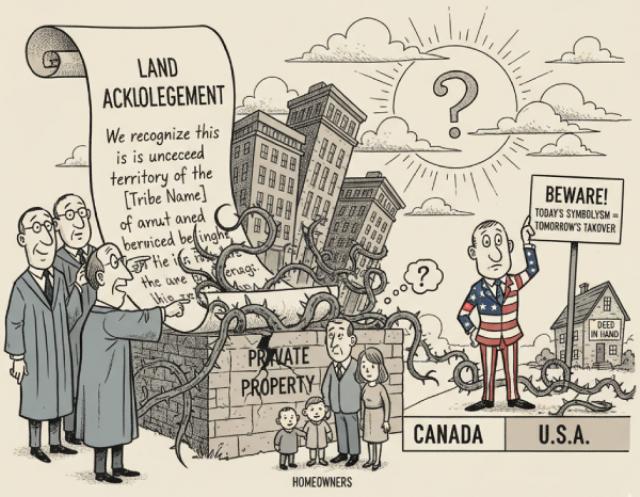
Left-wing “land acknowlegements” could be having real-world consequences for property owners in Canada. And the United States may be next.
It began as a polite ritual. Before meetings or ceremonies, institutions began acknowledging that their buildings sit on land once inhabited by Indigenous peoples: “We recognize this is the unceded territory of the [tribe name].” The practice, with roots in Australia as far back as the 1970s, was picked up in Canada following the 2015 Truth and Reconciliation Commission report and moved quickly from Canada to left-leaning universities, city councils and churches in the 2020s. Many saw it as a mere courtesy. But beneath the symbolism lies deeper political movement that could erode the very foundation of private property.
In Canada, that shift is already underway. A British Columbia Supreme Court ruling this year suggested that even privately owned, fee-simple land might rest on “defective and invalid” title if an Aboriginal title still exists. For a nation built on English common-law property rights, that's quite a statement. As columnist Kevin Klein warns in the Winnipeg Sun, Ottawa’s silence on the issue is turning Crown land — once considered secure — into “conditional land.” If the Crown’s title is conditional, how long before yours is?
Land acknowledgements may sound harmless, but they prepare the rhetorical ground for these legal arguments. Once governments, universities, and corporations declare publicly that their property sits on “stolen land,” they’ve already accepted the premise that they don’t actually own it. Activists then insist that recognition demands restitution — and suddenly the issue moves from ceremony to court.
That’s what’s happening in Canada, where some judges now treat Indigenous land claims as concurrent with existing titles. For investors, homeowners, and farmers alike, that’s a recipe for uncertainty — and eventually, seizure of land.
The Left insists this is “reconciliation,” not revolution. But the outcome is the same. Private property rights are fundamental to Western liberty. If property is always subject to retroactive moral judgments or undefined shared stewardship, ownership loses to temporary permission.
In the United States, land acknowledgements have also run rapid, typically in the same academic and bureaucratic circles that look askance at capitalism and private property.
None of this means ignoring history or dismissing past injustices, just refusing to let symbolic guilt erode the legal system. Reconciliation should not come at the cost of the rule of law. Governments must make clear that while we honor history, property rights remain absolute under modern law.
The growing unease north of the border is a warning to America: beware the moral language that undermines legal foundations. Today’s “land acknowledgement” may be tomorrow’s title challenge. And once you concede the premise that your land isn’t really yours, it may not be for long.
FOLLOW US ON


