



 Print
PrintFighting the instinct to reject new ideas
Human nature, for all its brilliance and resilience, carries a curious flaw: the instinct to respond to new ideas with negativity. It’s not always malicious or deliberate. Often, it’s reflexive, an automatic dismissal born from habit, fear, or the illusion of certainty. Present a fresh idea to a friend, a colleague, or even a loved one, and the first reaction is often “no,” “that won’t work,” or “we’ve tried that before.” Rarely does the initial response begin with curiosity or pause. Instead, it begins with resistance.
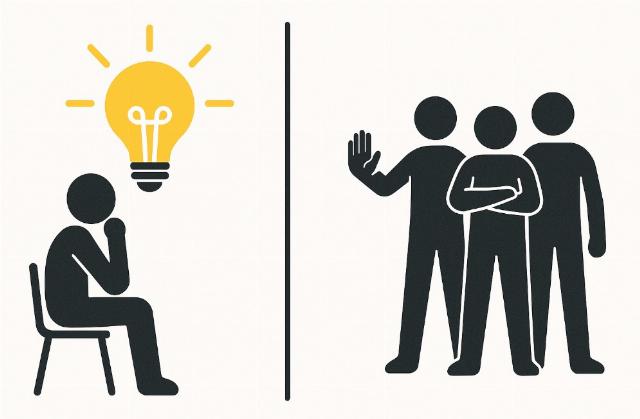
Image created using AI.
This pattern is not unique to any one person or culture. It’s a universal human tendency, deeply rooted in our evolutionary wiring. The brain is designed to detect threats faster than opportunities. In ancient times, this kept us alive. A rustle in the bushes was more likely to be a predator than a breeze. Better to assume danger and be wrong than to assume safety and be eaten. That same survival instinct now plays out in boardrooms, family kitchens, and casual conversations. A new idea is treated like a threat to stability, identity, or control.
But here’s the tragedy: in rejecting ideas too quickly, we often miss the very opportunities that could transform our lives.
When I’m approached with a new idea, I too feel that initial flicker of doubt. It’s natural. But I’ve learned to pause. I ask myself: “What if?” Instead of saying, “That can’t be done,” I ask, “What suggestions do you have that could make this work?” I’ve found that by asking the right questions, I uncover the right answers. And more often than not, the idea that seemed impossible begins to take shape. It grows. It evolves. It becomes something real.
This is the shift I wish to encourage in others, not just in how they respond to me, but in how they respond to life. When someone offers you an idea, don’t react. Reflect. Don’t dismiss. Absorb. Let the idea settle in your mind like a seed. It may not bloom immediately, but given time, it might sprout new thoughts, new connections, and new possibilities. That initial “no” might one day become “yes,” and eventually, “I executed it, and it worked.”
The challenge, of course, is cultural. We live in a world that rewards certainty and punishes ambiguity. People are praised for being decisive, not reflective. In conversations, the loudest voice often wins, not the most thoughtful. And when someone is confronted about their knee-jerk negativity, they double down, not because they’ve thought it through, but because backing down feels like weakness.
To change this, we must model a different way of engaging. We must show that curiosity is not weakness, it’s wisdom. That pausing before reacting is not indecision; it’s discernment. That asking questions is not a sign of ignorance, it’s the beginning of insight.
Imagine a world where ideas are treated like gifts, not threats. Where the first response is, “Tell me more,” not “That won’t work.” Where people see new thoughts as invitations to grow, not challenges to defend against. In such a world, innovation would flourish. Relationships would deepen. And the collective intelligence of our communities would rise.
This isn’t just idealism, it’s practical. The billion-dollar industry of positivity exists because people are trying to override their natural negativity. They buy books, attend seminars, and listen to podcasts not to learn something new, but to unlearn their reflexive doubt. They’re trying to rewire their minds to see possibility instead of peril.
And it starts with one simple shift: the willingness to pause.
When someone close to you reacts negatively to your idea, don’t fight them. Invite them. Say, “I’m not asking you to agree, just to consider.” Remind them that every great invention, every meaningful change, began as a thought that someone else doubted. And yet, someone believed. Someone asked the right questions. Someone gave the idea room to grow.
In time, they may come back to you and say, “You know what? That idea you had, I tried it. And it worked.”
That moment is worth the wait. It’s the reward for patience, for reflection, and for the courage to believe in possibility.
FOLLOW US ON


