



 Print
PrintTrump v. Slaughter: will the Constitutional win?
On December 8, the Supreme Court heard oral argument in Trump v. Slaughter. The issue is whether a President can fire a supposedly “independent” government functionary. More specifically, is there a fourth branch of government unaccountable to anyone other than, perhaps, the Congress that created it without any grounding in the Constitution?
The case arose when President Trump fired FTC Commissioner Rebecca Slaughter, not for cause, as authorized by the FTC statute, but because her service was “inconsistent with this Administration’s priorities.” Slaughter refused to leave office; hence the lawsuit.
Article II of the Constitution is as clear as it is concise:
The executive Power shall be vested in a President of the United States of America.
The Constitution also establishes the legislative and judicial branchs. Only the Supreme Court is established in the Constitution, which leaves it to Congress to establish “inferior” courts. That’s it: three branches and the President has all executive power, which means he’s entirely in charge of the Executive Branch. That hasn’t stopped Congress from creating various “independent” commissions and agencies supposedly beyond his reach.
The point, of course, is that those agencies will be filled with political "experts" beholden to the Congress. That’s an end run around the Constitution and a clear attempt to subvert the Constitutional powers of the Executive by creating a fourth branch of government—a more overt Deep State—beholden only to Congress, not the People.
Oral argument did not, according to most media accounts, go as they hoped. The questioning of the six judges normally favorable to the Constitution seemed to indicate they were leaning toward restoring the Executive’s full Article II powers.
Thus, the New York Times: “Justices Seem Ready to Give Trump More Power to Fire Independent Government Officials.”
The Supreme Court on Monday appeared poised to make it easier for President Trump to fire independent government officials despite laws meant to insulate them from political pressure in what would be a major expansion of presidential power.
Not so much. Should that come to pass, it would restore the Constitution to the Founder’s intent and to the sole, rational interpretation of the text. The self-described “wise Latina” argued, as usual, against the Constitution:
Justice Sonia Sotomayor told the administration’s lawyer that “you’re asking us to destroy the structure of government” and to “take away from Congress its ability to protect its idea that a — the government is better structured with some agencies that are independent.”
Riiiight, except the Constitution doesn’t give Congress that power. The Justice that embarrasses even the Wise Latina and Justice Kagan, was, as usual, oblivious to the Constitution:
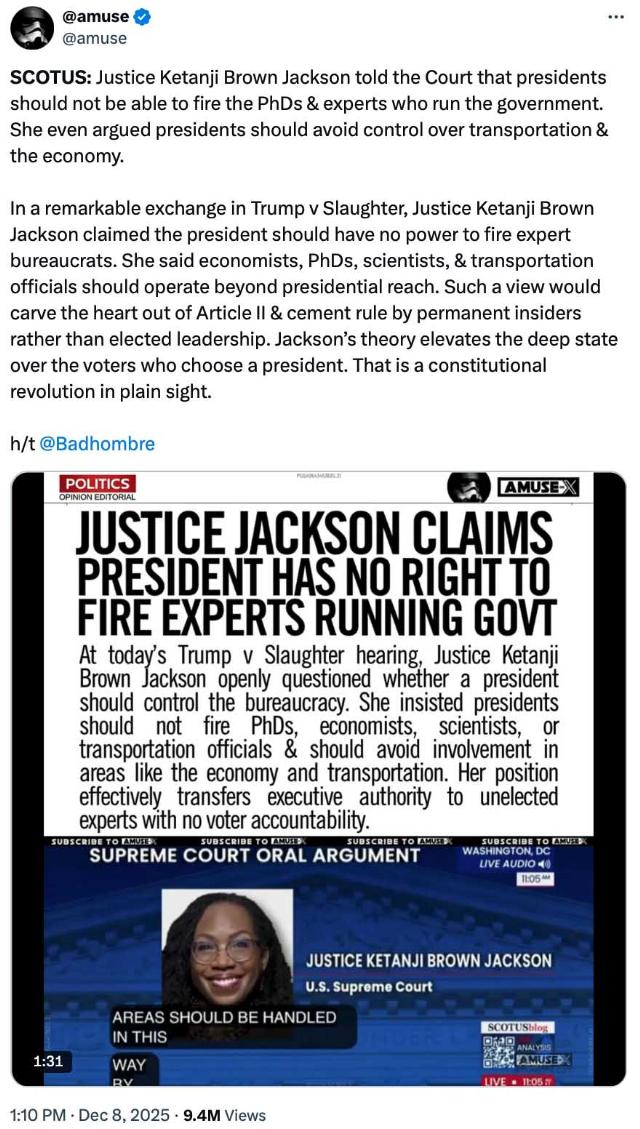
Graphic: Social Media Post
“So,” [Ketanji Brown] Jackson continued, “having a president come in and fire all the scientists, and the doctors, and the economists, and the Ph.D.s, and replacing them with loyalists and people who don’t know anything is actually not in the best interest of the citizens of the United States. This is what I think Congress’s policy decision is when it says that ‘these certain agencies we’re not going to make directly accountable to the president.’ So, I think there’s a pretty significant danger that Congress has actually identified and cares about when it determines that these issues should not be in presidential control.”
Well, Justice Jackson, in our constitutional, representative republic, the POTUS gets to do exactly that, and if the People don’t like his removal of those “experts” they can vote him out at the next election. That’s actual political accountability as the Founders intended. There is no fourth branch carve out that is unaccountable to the Executive but stealth accountable to the Congress.
Justice Gorsuch’s questioning of Slaughter’s attorney was likewise revealing:
Gorsuch: You agree that [a president] has a duty to faithfully execute all the laws?
[Amit] Agarwal: Yes.
Gorsuch: Civil and criminal?
Agarwal: We … agree that the Constitution imposes … on the president a duty to faithfully execute the laws, absolutely.
Gorsuch: All the laws?
Agarwal: Well …
Argarwal went downhill from there. John Hinderaker at Powerline has the last word:
I have often said that the government we live under is not the one that is described in the Constitution. A principal reason for this is that the branch of government that exercises the most power over us is the Fourth Branch, the one that the Constitution never mentions: the unelected alphabet soup of “independent” federal agencies. If the Court rules in the Administration’s favor, it will go a considerable distance toward establishing constitutional government, as well as political accountability. The president will now be responsible for the entire executive branch and will be able to implement his or her policies throughout the executive branch. Which no doubt is what voters thought was happening all along.
Voters? Who cares what the voters think?
Become a subscriber and get our weekly, Friday newsletter with unique content from our editors. These essays alone are worth the cost of the subscription.
Mike McDaniel is a USAF veteran, classically trained musician, Japanese and European fencer, life-long athlete, firearm instructor, retired police officer and high school and college English teacher. He is a published author and blogger. His home blog is Stately McDaniel Manor.
FOLLOW US ON


