


 Print
PrintRand Paul’s great idea goes begging
One of the big fights coming this January is how to reform the failing Obamacare program, aka, the Unaffordable Care Act. Without massive COVID-era subsidies, users will pay a lot more in 2026. The program itself has so many problems, beginning with the fact that many well-off people qualify, and so much money goes to directly fund insurance companies, no questions asked. It is more than past time to just let this whole mess disappear.
But many working people who don’t qualify for Medicaid need some options.
Sen. Rand Paul has perhaps the simplest and most effective answer, one that builds on the already existing ERISA plans big companies can currently offer their employees across state lines. Many ERISA plans are cheap to run because they are largely free of costly state mandates for coverage on expensive things like mental health and drug addiction therapy; items most families don’t need anyway.
Paul’s idea is to expand ERISA to offer simple Health Savings Accounts (HSA) plans via a host of non-profit membership groups most people already have access to: Credit unions, buying clubs, professional organizations, churches, etc. Take the small tax credits we already give HSA plans and raise them. This would be a great deal for most families and save the taxpayers a lot of money.
Sadly, this idea is making little headway in Congress. Partially because big insurance companies don’t see much benefit to them. But also, because of Paul personally. He has offered this type of legislation for years without success. I am afraid he has few friends and allies in the Senate. This summer, he was the most vocal Republican opponent of Pres. Trump's BBB, the Big, Beautiful Bill.
Sen. Paul made the perfect enemy of the pretty good. He insisted he would not vote for all the promised Republican tax cuts, nor the budget cuts to NPR and PBS, nor the expiration of the Obamacare subsidies, unless he got even more budget cuts elsewhere. Something most in Congress would not do.
If the senator had understood that legislation is a team sport, he might have gotten much of what he is proposing in his Health Marketplace and Savings Accounts for All Act. Senators in a narrow majority have a lot of individual clout in appropriations bills. Paul might have traded his yes vote to leadership for big chunks of his health care program the last several years; and then seen it up and running by now. Instead, he got nothing. None of the big budget cuts he sought took place while his HSA ideas went nowhere. Ironically, it was Pres. Trump’s BBB, the one Sen. Paul opposed, that contained the most recent HSA expansion.
And worst of all, in all his media appearances, you hear nothing from Sen. Paul about his important HSA legislation. Instead, he will bloviate like his father, Ron Paul, did for so long, with an obtuse understanding of Article 1 war powers. In their view, the U.S. military cannot be used without an explicit declaration of war. The problem for them is, that’s never been how the U.S. Constitution has been understood.
Starting with our first three presidents, Washington (the Indian Wars), Adams (the Quasi War with France), and Jefferson (The Barbary Coast Wars), all made war without declarations. Congress supported and limited these efforts with funding and various custom resolutions. That’s how it’s been done several hundred times throughout our history and the Supreme Court since 1800 has said that is completely okay. In our current situation, if the Congress does not like how Pres. Trump is using the U.S. Navy against drug cartels in Latin America, they are free to place restrictions on him. Just as Congress limited Presidents Nixon and Ford in the Vietnam War.
I would like to think that when Congress comes back to work in January, Sen. Paul could finally buckle down and do the hard work and horse trading necessary to pass his excellent Health Marketplace Act. I suspect, though, he and most of his colleagues will just continue to chase the shiny objects, like the Epstein files and whatever comes after that.
Frank Friday is an attorney in Louisville, KY.

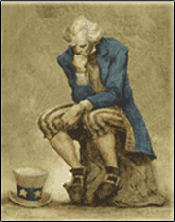
Image: AT via Magic Studio
FOLLOW US ON


