


 Print
PrintThe big, beautiful truth about Medicaid reform
Critics of the “One Big Beautiful Bill Act“ (OBBB, H.R. 1) have sounded the alarm, claiming that millions of Americans will lose health insurance, particularly under Medicaid. Many have highlighted Congressional Budget Office projections estimating that 7 to 10 million individuals could lose coverage over the next decade. But those numbers—though perhaps technically accurate—deserve closer scrutiny. The truth is more complicated and far less catastrophic than headlines suggest.
Rather than gutting Medicaid, Congress sought to rein in the program’s unsustainable growth, restore its original purpose, and protect it in the long term for the truly vulnerable. The debate over Medicaid reform deserves clarity, not fear. Far from gutting the program, the Big Beautiful Bill may be the first serious effort in decades to preserve it. Here’s what the legislation actually does—and why the dire warnings are misleading.
The Current Trajectory Was Not Sustainable
During the COVID-19 public health emergency, Medicaid enrollment surged due to a federal requirement that states keep recipients continuously enrolled. From 2020 to 2023, Medicaid/CHIP enrollment grew by 23.3 million, reaching nearly 95 million, primarily due to the continuous enrollment provision. However, many of those same Americans saw their incomes recover or exceed eligibility limits post-pandemic, which means they should no longer be eligible for the programs.
As a result, Medicaid now covers nearly 1 in 4 Americans and is projected to consume more than a third of many state budgets within a decade. The OBBB reduces federal spending by roughly $930 billion over ten years by curbing provider taxes, trimming supplemental payments, and tightening eligibility enforcement. These are better characterized as structural corrections than indiscriminate cuts.
The “Loss” of Coverage Is Largely Administrative
The CBO projections are based largely on expected reductions in enrollment due to more frequent eligibility checks and the introduction of work requirements. But “losing coverage” under Medicaid doesn’t necessarily mean being denied due to income or disability status. In many cases, it reflects failure to file paperwork or maintain enrollment in a timely manner.
For example, when Arkansas implemented work requirements in 2018, most disenrollments were due to missed reporting deadlines or a lack of understanding of the policy, rather than recipients no longer being eligible. The same pattern is expected under this bill.
Candidly, those supporting work requirements would do well to learn from Arkansas’s experience, which a federal court halted in 2019 due to administrative flaws. By the end of 2018, over 18,000 individuals had lost coverage because of noncompliance with reporting, not because of ineligibility.
States may be able to mitigate coverage loss by clarifying reporting requirements and providing administrative support for online portals for those with limited computer skills, better data management, and effective communications. In Arkansas, some individuals didn’t receive proper notification due to outdated contact information or confusing state correspondence.
Other administrative reforms include stricter documentation standards for applicants and enrollees. The OBBB seeks to reduce duplicate enrollments under Medicaid and CHIP (Children’s Health Insurance Program) by requiring more accurate and frequent documentation at enrollment.
Duplicate enrollment in Medicaid and CHIP across multiple states is a recognized challenge that contributes to waste, fraud, and unnecessary spending. Although states are mandated to use the Public Assistance Reporting Information System (PARIS), its effectiveness has been limited by delays in reporting and outdated technology. Some believe that establishing a real-time federal database for PARIS would be a solution for identifying duplicate enrollments.
The OBBB attempts to tighten PARIS accountability by establishing stricter oversight of how quickly and effectively states respond to matches and duplicates, requiring a closer alignment with state enrollment records. It also mandates that states act on eligibility matches more promptly and coordinate more closely with other systems, such as the federal Death Master File. If an individual is misidentified as deceased, the state “shall immediately re-enroll the individual to the date of such disenrollment.”
Work Requirements Are Not New—and Not Unreasonable
The bill requires able-bodied adults aged 19–64 to work, attend school, train, or search for a job, or volunteer for 80 hours a month to retain non-emergency Medicaid benefits. Exemptions include caregivers, students, and those with medical conditions. Other exemptions include pregnant women, individuals who are medically unfit to work (including due to mental illness), institutionalized individuals, and American Indians and Alaska Natives. Some states allow exemptions for the homeless and foster youth up to age 26. These requirements mirror longstanding federal policy under the Temporary Assistance for Needy Families (TANF) program, which has included work requirements since 1996.
Most adults on Medicaid already work. By reinforcing that reality, the bill narrows eligibility to those who truly need the subsidy and restores Medicaid’s original mission.
Originally designed to serve the poor, disabled, and elderly, Medicaid has, over time, become a default insurance option for millions of able-bodied adults, many of whom could transition to subsidized coverage through the Affordable Care Act or employer-sponsored plans.
Retroactive Coverage Limits Encourage Timely Enrollment
One misunderstood provision in the bill is the provision reducing Medicaid’s retroactive coverage window from 90 days to 30 days. This means Medicaid will only reimburse providers for care received up to one month before an applicant is approved.
Critics argue that this leaves patients and hospitals exposed. However, many private insurers already operate without retroactive coverage. States like Iowa and Florida have already implemented similar limits with no documented systemic harm. A shorter window encourages proactive enrollment and allows more predictable budgeting for states.
Illegal Alien Enrollment
Many have falsely stated that the OBBB “kicks off immigrants” or bans illegal aliens. In truth, illegal aliens have never been eligible for full-scope Medicaid under federal law. Immigrants will continue to be eligible for Emergency Medicaid, as required under existing federal law (42 USC §1396b[v]).
The OBBB tightens Medicaid eligibility rules for immigrants or reinforces or codifies restrictions already in place. The OBBB governs only federal Medicaid dollars, not state-funded health initiatives.
For example, the OBBB codifies a tighter, uniform definition of who is “lawfully present” for Medicaid, effective October 1, 2026, and imposes a consistent five-year wait on green card holders. Waivers that some states granted to children and pregnant women will end.
As such, the BBB reaffirms that full Medicaid coverage will only be available to:
- U.S. citizens or nationals
- Lawful permanent residents (LPRs) (green card holders with a 5-year wait)
- (COFA migrants) under the Pacific Islands Compacts of Free Association.
- Continuation of carve-out for aliens granted the status of Cuban and Haitian entrant, “as defined in section 501(e) of the Refugee Education Assistance Act of 1980.” Cuban and Haitian refugees are also specifically exempted from the 5-year waiting period that applies to most other lawful immigrants.
The bill also mandates stricter immigration status verification and semi-annual eligibility reviews to curb improper enrollment.
Regarding Medicaid provisions, the OBBB is far from reckless. It restores accountability to a program that has ballooned under emergency policies and administrative inefficiency. The bill closes loopholes, promotes personal responsibility, reduces duplication and waste, and seeks to ensure that Medicaid is available long-term to those who truly depend on it.

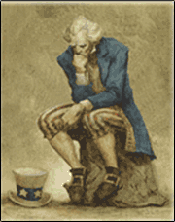
Image: Pkd2016 via Wikimedia Commons, CC BY-SA 2.0.

FOLLOW US ON


