



 Print
PrintTrump’s optimistic America-First National Security Strategy
Trump’s 2025 National Security Strategy (NSS) is a timely, optimistic, and practical blueprint that prioritizes “core national interests” and the well-being of the American people. At the same time, it repudiates participation in globalist projects that aim to manage the entire world. Making a sharp break with the post–Cold War foreign policy consensus, it prioritizes and advances the America First agenda that seeks peace through strength and abandons the traditional “everything, everywhere” posture. It argues that U.S. policy should no longer be bound to global institutions and humanitarian crusades that undermine American sovereignty.
Trump’s national strategy is pragmatically defined as
a concrete, realistic plan that explains the essential connection between ends and means: it begins from an accurate assessment of what is desired and what tools are available, or can realistically be created, to achieve the desired outcomes.
A strategy must evaluate, sort, and prioritize. Not every country, region, issue, or cause — however worthy — can be the focus of American strategy. The purpose of foreign policy is the protection of core national interests; that is the sole focus of this strategy.
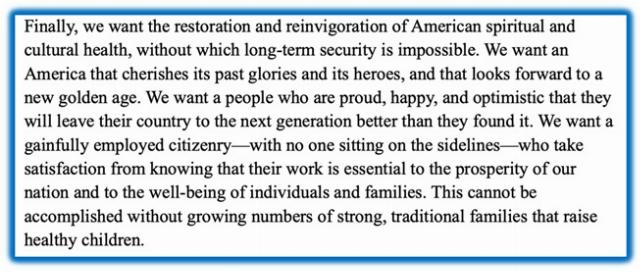
The document leads with what the U.S. “should want” for itself. In summary, its key domestic aims should be secure borders and controlled migration, balanced trade, a resilient infrastructure, military supremacy and nuclear deterrence, economic and industrial might, energy dominance, technological leadership and soft power, and spiritual and cultural renewal. Unusual for an NSS, President Trump’s vision calls for “restoration and reinvigoration of American spiritual and cultural health,” emphasizing traditional families, work, and optimism about the future of the nation:
Trump’s domestic agenda is tied directly to national security. Rooting out DIE practices that degrade institutions and deplete individual motivation is a top priority. The NSS emphasizes competence and merit as core goals that give the nation “civilizational advantages.” Notably, the document also recognizes the need to avoid focusing on meritocracy to the exclusion of employing domestic talent (the H-1B controversy):
We cannot allow meritocracy to be used as a justification to open America’s labor market to the world in the name of finding “global talent” that undercuts American workers. In our every principle and action, America and Americans must always come first.
Trump’s NSS seeks to rebuild the middle class with tax cuts and deregulation, among other strategies. Unleashing domestic energy production is another top priority. He recently commented that he has authorized the replenishing of the strategic petroleum reserve that Biden drained. The overarching idea is that economic security is national security. Trump believes that the foundation of American power comes from rebuilding industrial and energy strength.
The NSS document sets out explicit priorities for the nation. First and foremost, the “era of mass migration is over.” The NSS argues that, as a primary element of national security, mass migration has strained resources, increased crime, and undermined cohesion in all Western countries. Measures to tighten border security include addressing terrorism, drug- and human-trafficking, and espionage.
Notably, the document also addresses more nuanced issues having to do with the political and cultural lexicon. It faults what it implies is the left’s use of political language to justify abuses of power. In that light, terms such as “deradicalization” and “protecting our democracy” are portrayed as linguistic weapons — forms of gaslighting that serve as a pretext for advancing their agenda through the power and tools of the federal government. Instead, it recenters the “purpose of the American government” on securing “the God-given natural rights of American citizens.” Free speech and a government represented by the people are rights that must “never be infringed.” It also criticizes elitist restrictions on civil liberties in allied democracies.
Additionally, the NSS states that the U.S. will no longer be “Atlas,” fighting alone with the world on its shoulders. Burdens will be shared by pushing wealthy allies to assume responsibility for their regions. Highlighted here is the “Hague Commitment,” under which NATO countries pledge “to spend five percent of GDP on defense” as the new standard.
Trump aspires to be the “President of Peace,” pointing to his diplomatic peace-making achievements in multiple regions. He believes that presidential deal-making can extinguish regional wars before they trigger global conflict.
Finally, he prioritizes economic security with balanced trade and energy dominance, including a rejection of “Net Zero” climate policies viewed as harmful to U.S. and European security. Trump wants to reindustrialize the U.S. and reshore technology wherever possible. The document also advocates strongly for securing critical supply chains and materials, echoing Alexander Hamilton’s warning against dependence of foreign suppliers for defense-critical goods.
On foreign policy, the NSS narrows U.S. objectives to a handful of “core, vital national interests”:
- Western Hemisphere: A stable, well governed region that discourages mass migration, cooperates against cartels and transnational criminal groups, remains free of hostile foreign ownership of key assets, and supports critical supply chains. The U.S. will enforce a “Trump Corollary” to the Monroe Doctrine to keep non-hemispheric adversaries out. He plans to adjust military posture, including a more robust Coast Guard and Navy presence and targeted deployments against cartels, potentially using lethal force if necessary.
- Indo-Pacific: A “free and open” Indo-Pacific, secure sea lanes, and reliable supply chains and access to critical materials, especially against China’s economic and military challenge. This region is being recognized as a central economic and geopolitical battleground of the 21st century. It is not a given that China will be integrated into trade and investment, especially with regard to “sensitive” investments like rare earths and chips.
- Europe: Support for allies in preserving European freedom and security, coupled with an explicit call to restore Europe’s civilizational self-confidence and Western identity. Trump will encourage much higher European defense spending and capabilities. He is also working to address the “unsustainable” account deficit in global trade. NATO will no longer be a perpetually expanding alliance, and the NSS advocates for more robust action against “mercantilist overcapacity, technological theft, cyber espionage, and other hostile economic practices.”
- Middle East: Prevent any adversarial power from dominating the region’s oil and gas and the chokepoints through which they flow — while avoiding the “forever wars” of the past.
- Africa: The U.S. will pivot from spreading liberal ideology and traditional aid programs that are known money pits with little to no accountability. Trump seeks to resolve conflicts and prevent new ones while remaining wary of Islamist terrorism and avoiding long-term deployments or commitments.
- Technology standards: Ensure that U.S. technology and standards, particularly in A.I., biotech, and quantum computing, drive global development rather than rival authoritarian models.
One of the president’s core responsibilities is to protect the homeland while realistically sizing up the forces that threaten it. Trump is overall an intensely aspirational figure, and that outlook shapes an administration that approaches national security from a position of strength and optimism — despite the constant chorus of critics.
As the NSS lays out, the United States still enjoys an innovative economy, leading financial markets, a dominant technology sector, the most capable military, a wide alliance network, favorable geography, and unmatched “soft power.” Whether Trump will be allowed to finish the mission he has set for himself remains to be seen, but there is no mistaking that this strategy embodies the ethos of the man behind it.
Image: Gage Skidmore via Flickr, CC BY-SA 2.0.
FOLLOW US ON


