


 Print
PrintSymbolism isn’t strategy: Reflection on protest and policy
This past Saturday, the “No Kings” protest swept across major cities in the United States, drawing thousands of demonstrators, many of them older Americans in their 50s, 60s, and beyond, marching with signs, chanting slogans, and singing songs of resistance. The energy was theatrical, the messaging dramatic. But as I watched the coverage, I found myself asking a deeper question: What was the objective?
The central theme of the protest was a rejection of authoritarianism, with slogans accusing President Trump of acting like a king. Some held signs that read “Save Democracy,” while others chanted “No Kings, No Tyrants.” One of the more theatrical moments featured former Speaker Nancy Pelosi breaking a golden crown in half on stage, symbolizing the rejection of monarchical rule. It was a spectacle, but one devoid of substance.
Let’s be clear: the United States is a constitutional republic, not a monarchy. The president, any president, is bound by the separation of powers, checked by Congress and the courts, and ultimately accountable to the people. To claim that Donald Trump is a king is not only constitutionally inaccurate, it’s intellectually dishonest. In fact, Trump’s presidency has been the opposite of monarchical rule.
He has championed law and order, restoring respect for the rule of law in cities plagued by chaos. He has emphasized fiscal responsibility, cutting wasteful spending and renegotiating trade deals that benefit American workers. He has pursued peace through strength, brokering historic agreements in the Middle East and reducing America’s entanglement in endless wars. He has revitalized the economy, bringing back manufacturing jobs, lowering unemployment, and improving wages for working-class Americans. These are not the actions of a king, they are the actions of a constitutional executive committed to national renewal.
Contrast this with the protest itself. While the crowd was loud, it was not clear. While the slogans were passionate, they were not persuasive. There were no concrete proposals, no legal arguments, no alternative models of governance. Just slogans. Just noise. Just theater.
And the theater was unmistakably partisan. The protest was dominated by Democratic figures, many of whom have held power for decades. These are not outsiders challenging tyranny; they are insiders performing outrage. Their presence at the rallies, their dramatic gestures, and their emotionally charged speeches were not about solutions, they were about symbolism. They screamed “Save Democracy” while offering no debate. They chanted “No Kings” while ignoring the constitutional safeguards that already exist. They broke crowns on stage while failing to build anything of substance.
Numerous celebrities joined the “No Kings” protests, amplifying the theatrical atmosphere with chants, songs, and social media performances that prioritized spectacle over substance.
From coast to coast, Hollywood and music industry figures turned out in force. Mark Ruffalo called the protests a “historic moment” and urged Americans to “rise up” on social media. Jamie Lee Curtis marched in Los Angeles, posting photos with captions like “Democracy in ACTION!” while Spike Lee rallied in New York, shouting “GET UP STAND UP” to his followers.
Yet despite all the protesting, the chanting, the slogans, the court battles, and the grandstanding—the American people are seeing through it. They are wise. They are discerning. And they are waking up. Rather than Trump’s favorability ratings declining, it has remained strong, with many Americans rejecting the distortion of truth and unsubstantiated accusations leveled by partisan actors.
This awakening was dramatically witnessed during the last election, where Trump won all the swing states, the popular vote, and the electoral college. That is not the mark of a nation rejecting its leader, it is the mark of a nation reclaiming its voice. And that voice is not found in chants or broken crowns, it is found in ballots, in reasoned debate, and in constitutional clarity.
This is the crisis of our time: symbolism has replaced strategy, and emotion has replaced reason. Too often, public discourse is reduced to caricature, where disagreement is treated as tyranny, and metaphor replaces logic. But if we are to preserve the legacy of our republic, we must do better. We must return to reasoned debate, grounded in history, law, and common sense.
Protest alone does not restore the republic. Ideas do. Solutions do. Accountability does. And above all, truth does.
President Trump’s policies, whether one agrees or disagrees, exist in the realm of action. They are debated, codified, and implemented. That is the essence of democratic engagement: not just protest, but policy. Not just grievance, but governance.
The “No Kings” protest, for all its theatrical flair, failed to articulate a vision. It failed to offer a path forward. It failed to engage in the kind of civic dialogue that strengthens a republic. Instead, it relied on metaphor, emotion, and performance.
As a legacy-driven citizen, I believe we must rise above the noise. We must demand clarity, not just passion. We must seek solutions, not just slogans. And we must remember that the strength of our republic lies not in the volume of our protests, but in the integrity of our ideas.
Let us restore the art of debate. Let us honor the Constitution not with crowns and chants, but with reason and responsibility. And let us remember that true leadership is not about power, it’s about service.
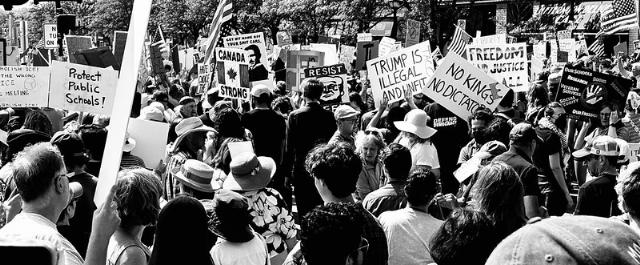
Image: Dennis Sparks, CC BY-SA 2.0, via Flickr, unaltered.
FOLLOW US ON


