


 Print
PrintThe Surrender of Academia: Blood Libel at UCL
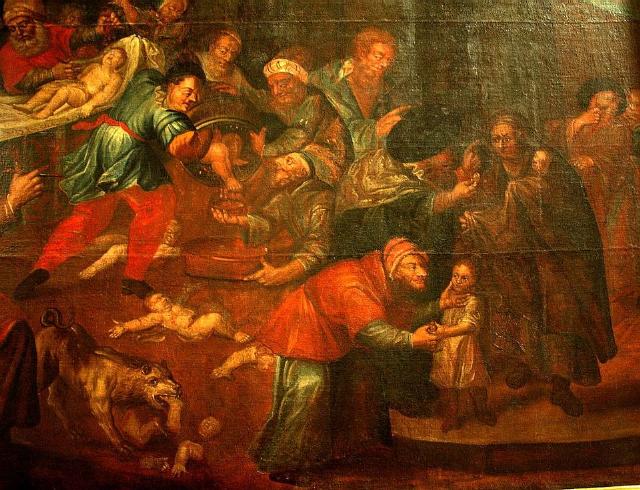
From Wikimedia Commons: Blood Libel (Karol de Prevot, 18th Century)

On the evening of November 11, 2025, University College London provided a lecture theatre and official student-society imprimatur for an event at which Dr. Samar Maqusi, a former fixed-term researcher at UCL and previously employed by the UNRWA for Palestine Refugees, delivered the opening lecture in a five-part series entitled “Palestine: From Existence to Resistance”, organized by the university’s recognized Justice in Palestine Society. From the very beginning, there was no hesitation or pretense. On the contrary, the darkest prejudices of the past were brought to life. The lecturer was undaunted.
In the course of her talk, “The Birth of Zionism”, Dr. Maqusi meticulously recounted the 1840 “Damascus Affair” as though it were historical fact: that Jews in Damascus had kidnapped a Capuchin monk, Father Thomas, drained his blood, and used it to bake “special pancakes or bread” for a “holy ceremony”. She stated explicitly (a) that “part of the holy ceremony is that drops of blood from someone who’s not Jewish… has to be mixed in that bread”, and (b) that the accused Jews, who were tortured to the extreme, had “admitted” to the murder. The Damascus blood libel—one of the most notorious antisemitic fabrications in history, which triggered pogroms across the Middle East and Europe—was thus revived on a UCL platform eighty years after the liberation of Auschwitz.
Only after video footage of the lecture went viral on social media on November 13, and only after sustained pressure from Jewish students, the Community Security Trust, the Board of Deputies of British Jews, and numerous public figures, did UCL at last find the courage to act. That very same day, the Provost, Dr. Michael Spence, issued an “unequivocal apology”, describing the remarks as “heinous antisemitic comments” and affirming that “antisemitism has absolutely no place in our university”. Dr. Maqusi was banned from campus, the Justice in Palestine Society was barred from holding further events pending investigation, and the incident was referred to the police. The sequence is instructive: outrage first, institutional response second. There was no pre-emptive intervention, no refusal to host, no evidence that anybody in authority had even reviewed the speaker’s script or past statements. The university did not defend historical truth until it was forced to do so under threat of exposure.
Of course, this is not an isolated scandal; it is the logical endpoint of a decades-long moral and intellectual collapse in Western academia. Departments of Middle East Studies, Postcolonial Studies, Gender Studies, and the proliferating “decolonial” disciplines have for years cultivated an environment in which the open expression of Jew-hatred is tolerated—provided it is framed as “anti-Zionism”, “resistance” or “speaking truth to power”. Blood libels, the celebration of Hamas’s October 7, 2023, massacre as “decolonization”, and calls for “global intifada” are no longer fringe positions on British campuses; they are performative requirements for progressive bona fides. Jewish students, who are frightened and object, are routinely told that their discomfort is a form of “Zionist anxiety” or “white fragility”. The inversion is complete: the heirs of those, who survived the Holocaust, are lectured on privilege by tenured academics whose salaries are ultimately paid by the liberal civilization that they now treat with contempt. Political theater has surrendered to the grotesque.
Why this silence from the professoriate? The answer is a lethal cocktail of cowardice and ideological delusion. For half a century, Western academia has indoctrinated its students with the dogma that all cultures are merely different, never superior or inferior; that secularism, individual rights, and the rule of law are not universal achievements but “Western” impositions tainted by colonialism; that the only morally legitimate stance towards the non-European world is one of uncritical solidarity with its self-described victims. This relativism was always intellectually bankrupt, but it becomes existentially suicidal when applied to political Islam.
We invaded Iraq and Afghanistan believing that beneath every burqa and beard beat the heart of a liberal democrat waiting to be liberated. The results—twenty years of blood and treasure in Afghanistan, culminating in the Taliban’s triumphant return in 2021, and the re-emergence of sectarian theocracy in Iraq—exposed the depth of our delusion. Large swathes of the Islamic world deeply resent us and have never desired to become like us; significant portions actually expect us to submit sooner or later and become like them. Decades of Pew, Gallup, and Arab Barometer surveys have documented majority or plurality support in numerous Muslim-majority countries for sharia governance, the death penalty for apostasy, the subjugation of women—and, crucially, for antisemitic beliefs of medieval virulence. These are not the views of a tiny extremist fringe; they are mainstream.
Yet to state these facts in a British or North American university common room is to invite professional ostracism under the catch-all accusation of “Islamophobia”. The same scholars, who claim to “punch up”, fall mute when the power in question is wielded by Hamas, Hezbollah, or the Muslim Brotherhood’s campus subsidiaries. It is safer to issue a belated apology than to prevent the outrage in the first place. It is safer to equate criticism of Islamism with racism than to acknowledge that the racism in question is frequently directed, with medieval ferocity, against Jews.
The barbarians are no longer at the gates. Storming our universities, they have been issued UCL lanyards and lecture-theatre bookings. Student societies that openly endorse ideologies, which stone adulterers and execute homosexuals, are granted institutional privilege in the name of “diversity”. Meanwhile, Jewish students require security escorts to attend classes. The university, once the guardian of reason against superstition, of evidence against myth, of the individual against the mob, has abandoned its post—not because the evidence has changed (the Damascus blood libel remains a lie, Hamas remains a sadistic terrorist organization), but because confronting the truth about political Islam now requires a courage that contemporary academia simply does not possess.
The consequences are not confined to campus. Every time a university platform rehabilitates the blood libel, it normalizes the idea that Jewish life is negotiable. Every time a Students for Justice in Palestine chapter invites a speaker, who celebrates October 7, it trains a generation to regard the largest massacre of Jews since the Holocaust as legitimate “resistance”. These are rehearsals for violence. We saw the dress rehearsal in the pogroms that swept Amsterdam in November 2024, when mobs hunted Jews while chanting “Allahu Akbar”. We saw it in the fire bombings of synagogues in Germany and France. Indeed, we will see it again unless academia recovers the elementary distinction between civilization and barbarism.
There was a time when European intellectuals understood that “civilization is a fragile achievement that must be defended”—sometimes by force, always by moral clarity. That understanding has been replaced by a “suicidal multicultural dogma” which insists that all cultures are equal except Western culture, irrevocably weighed down by “colonial guilt”. The result is a continent that has imported millions of Muslims socialized in environments, where Jew-hatred is mother’s milk, then expresses bewilderment when those attitudes manifest in university lecture theatres and on the streets.
Until academia resumes traditional virtues and shows the Western Enlightenment courage to distinguish between truth and lies, e.g., to declare—without waiting for a viral video and a Twitter storm—that draining a monk’s blood for matzah is a malicious fabrication, wherever and whenever it is cited, the surrender will continue. And the barbarians—many of them, ironically, wearing the jeans and checked lumberjack shirts that we once mistook for “talismans of assimilation”—will keep advancing, lecture theatre by lecture theatre, belated apology by belated apology.
We were told after 1945 that “Never Again” was more than a slogan. However, eighty years later, a British university required days of external pressure before it could bring itself to condemn the blood libel in its own lecture hall. If this is the best that our centers of higher learning can manage, the post-war promise has already been broken—not in the gas chambers, but in the seminar rooms where the next generation is taught that truth is negotiable, courage is bigotry, and Jewish blood is, once again, cheap.
FOLLOW US ON


