

 Print
PrintThe Eco-Socialist Dream Is Going to End Ugly
The German government has shifted into hyper-mode to defend its green patronage economy. To pay for it, heirs, high performers, and savers are being drafted into service. The end of the eco-socialist nightmare will be convulsive and chaotic.
On Friday, the federal cabinet agreed to introduce a new EV subsidy. Roughly three billion euros are set to flow into this bloodless market segment over the coming years -- a drop in the bucket compared to the vast sums used to artificially keep the green patronage complex alive. But it is a signal.
A negatively sloped learning curve
The decision joins a long list of political misfires in recent months -- a list unlikely to end with subsidized industrial electricity, heat pumps, or refinancing packages for wind turbines. The state simply has too much money at its disposal to be forced to abandon its wasteful, destructive project.
For Bavaria’s minister-president Markus Söder, the revival of this failed subsidy instrument was cause for a small celebration. He promised a “huge boost” for the domestic market, claiming state intervention would secure value creation and jobs -- a thoroughly “Söderized” view of reality.
Once again, Söder proved that his personal learning curve has flattened into a downward-sloping line -- a phenomenon broadly visible across European politics.
Debt union and professional manipulators
Germany’s EV subsidy stands pars pro toto for the broader European situation. Public debt is exploding across nearly all EU member states. Next year, Germany will post net new debt of around 5.6% of GDP -- placing it among Europe’s top debt creators.
This figure is honest -- and shows the true fiscal position once the government’s accounting tricks, exemptions, “special funds,” and skyrocketing municipal debts are properly added back in.
France and the UK look equally grim. Even once-disciplined Finland is stumbling toward 90% debt-to-GDP with a similarly large deficit. It can no longer be denied: Europe is trapped in a debt spiral.
Schäuble and the Troika
How times have changed. Some may recall the theatrically staged visits of former German finance minister Wolfgang Schäuble and the Troika, who -- with maximal media firepower -- pinned the sovereign debt crisis squarely on Greece.
In reality, it was perfect camouflage -- designed to divert attention from the bailout of Germany’s banking and insurance sector, which had sailed into heavy waters due to political mismanagement.
The public was never meant to see what is now obvious: the EU has degenerated into a debt club trying to execute its ideological mega-projects -- like the green transition -- through a credit pump, with taxes and inflation serving as the extraction mechanism from ordinary citizens.
Heirs, asset holders, small business owners, and the productive middle will pay the bill. The emotionally charged debate over inheritance taxes -- and the faux rhetoric about “fairness” -- reveals that the political class is now openly planning the confiscation of accumulated private capital.
Inflation as a hidden tax
The permanent crisis will inevitably lead to a growing state apparatus -- a debt-financed Leviathan that accelerates the inflation spiral with every intervention. No one is supposed to notice how quickly money loses value in this environment. The seigniorage -- the hidden gain -- goes to the biggest debtor of all: the state.
 With every new green initiative, every EV subsidy, every publicly funded wind turbine, the bill rises. Only the delayed price effect helps politicians obscure cause and effect and decontextualize the economic damage of their intervention.
Von der Leyen, Merz, Macron & Co. rely heavily on this effect. They hope the majority of voters never add one and one together -- and never question the soft-edged tax squeeze and deliberate erosion of their savings.
The state versus economic reason
The intellectual collapse of politics reveals itself precisely in this moment of fiscal breakdown. One gets the impression none of today’s political representatives have ever opened a book on 20th-century economic history. Had they looked into Europe’s past, they would know their attempt to escape a deep productivity crisis through debt-financed state demand is doomed.
What Merz and his economically illiterate cabinet are doing is nothing less than a direct assault on the private economy. The expanding state sector -- already consuming more than 50% of German GDP and 57% in France -- crowds out private economic activity. This has been so severe that German productivity growth has trended negative since 2018.
And everything rests upon this: the social state -- from education to welfare to generous migration policy -- requires real economic growth of at least 2.5% annually. The illusion of stability is in free fall. Public faith in the omnipotent state shrinks with every month of recession and absent growth.
The 90% threshold
Who will explain to future citizens that the exalted climate narrative served primarily to construct a new socialist regime, replacing what remained of the social market economy? Who will tell them that the push to control digital platforms and private communication merely aimed to silence dissent over this civilizational rupture?
Merz and finance minister Lars Klingbeil are steering Germany toward the critical 90% debt-to-GDP threshold -- likely to be breached by 2030 -- after new borrowing of 4.2% this year and 5.6% next year.
The 90% mark, according to the landmark 2013 Reinhart-Rogoff study, represents an economic tipping point: beyond it, the public sector adopts increasingly aggressive, parasitic policies that crowd out private investment.
In short: the state commandeers growing portions of the productive sector for debt service, bureaucracy, and interventionism -- erasing growth and prosperity.
Critics targeted according to state logic
Predictably, this analysis came under heavy fire from Keynesian economists and state-aligned media. It emerged during the post-2008 debt crises, when the political class discovered it could “solve” systemic damage by increasing the dose of the very medicine that caused it.
A return to market economics has thus been suspended.
No system limits political power more effectively than the free market. Policymakers in Brussels, Berlin, Paris, and London know this -- which is why its defenders are systematically ridiculed.
We watch helplessly as libertarian leaders like Argentina’s Javier Milei or the deregulatory agenda of Donald Trump are reflexively smeared, distorted, and degraded by state-friendly media.
Waiting for the shock
The end of the technocratic illusion and its eco-socialist command system arrives the moment the first domino in the debt chain falls. We cannot say when this will happen -- but the probability that France, an unreformable statist colossus, will be the first to receive the red card from bond markets rises daily.
A French default is something even massive ECB intervention may no longer prevent. It would trigger a simultaneous fire sale of European sovereign bonds -- vaporizing the common currency.
Friedrich Merz, Lars Klingbeil, and Ursula von der Leyen will then blame Donald Trump, Vladimir Putin -- or perhaps the Chinese. Citizens will be left to pick through the wreckage of this latest socialist experiment. In the midst of the politically manufactured migration crisis, they will be fighting for their economic survival in increasingly heterogeneous social pressure zones.
Many will ask themselves whether it was worth sacrificing their freedom, prosperity, and political stability to a climate deity that ultimately reveals itself as nothing more than a political power construct -- a destructive narrative.
At the end of the illusion lies the poverty trap.
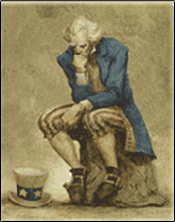
Image: RawPixel.com
FOLLOW US ON


