



 Print
PrintPartisan Gerrymandering? Not a Problem
Last week’s Supreme Court order upholding Texas’s revised congressional districts unleashed a torrent of complaints about how supposedly partisan the Court has become. Adam Liptak, the New York Time’s Supreme Court analyst who can be counted on to give any decision a leftward spin, published a piece on December 6 proclaiming the Court was “all in” on partisan gerrymandering.
Well, so am I. The difference between Adam Liptak and me is that I see politics. And politics are normal. Indeed, politics ought to be done by politicians who are elected because of their policies (notice a similarity in those words?), not by unelected judges. Politics is not necessarily nefarious nor unconstitutional, as Liptak infers.
Representation is an inherently political act. Always has been, always will be. The Constitution mandates occasional reapportionments, which protects the United States from the British experience of “dead boroughs” -- seats in Parliament historically sanctioned that no longer justified existence but were not abolished. Beyond that, it’s fair game.
Indeed, the word “gerrymander” points to the politics of it. In the early 1800s, Elbridge Gerry, governor of Massachusetts from what would indirectly become today’s Democrat party, approved a district that twisted around towns in such a way as to resemble a salamander and favor his party. Gerry + salamander = gerrymander.
If voters give a party a majority in a legislature, why are we surprised they would design representation to enhance their chances at staying in power? That’s not illegal.
As Democrats began losing control of more and more state legislatures and/or governorships in the Bush 43 and early Obama eras, suddenly Democrats -- the party whose ancestors invented the gerrymander -- found it “unfair,” even “unconstitutional.” A group of liberal Democrats tried to turn the issue into a constitutional case (“gerrymanders deny voters their constitutional rights”). The federal courts played with the theory. Adam Liptak even cites a fractured Supreme Court (split 4-1-4) that couldn’t decide if gerrymandering was or wasn’t constitutional. The side tending toward unconstitutionality was unable to agree on what made gerrymandering a violation of the Constitution. Indeed, they couldn’t say what was legal v. illegal gerrymandering.
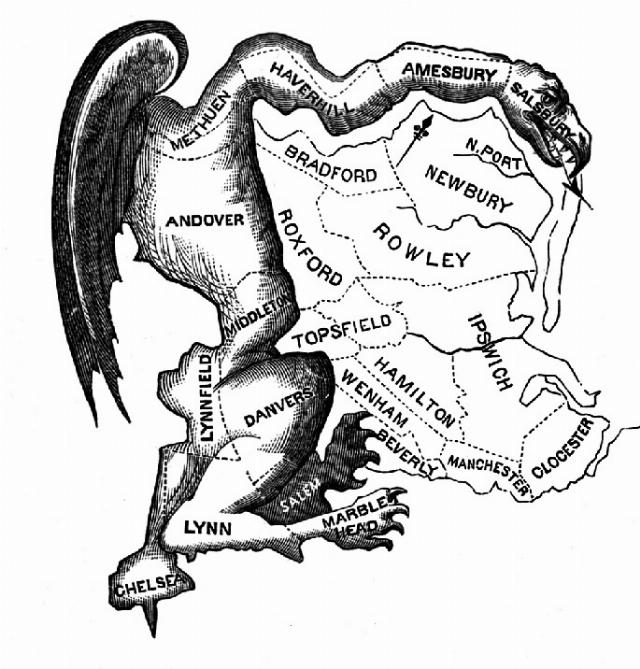 After leaving power, Barack Obama’s attorney general, Eric Holder, made it a crusade to sue states, trying to get redistricting maps unfavorable to Democrats pronounced unconstitutional. He wasn’t overwhelmingly successful. (Of course, he also wasn’t going after the “balance” in Massachusetts’ nine congressional districts which -- surprise -- are all bright blue Democrats, even though Trump took 35% of the Massachusetts vote in 2024).
What Liptak wants to cast as the Supreme Court becoming “partisan” (code word for “stooge of Republicans”) is its moving away from this theory that allocation of seats after apportionment is a question for the courts. The Court has instead returned America to its original, historical approach: apportionment is a political question, and political questions are generally not justiciable, i.e., subject to judicial review. Political questions are generally policy choices, and it’s not the job of unelected judges to look over the shoulders of politicians to decide which choice is “better” (or to pretend that “better” is the only “constitutional” choice). The job of shoulder-gazing is not judges’ but voters’.
I’d argue that the Supreme Court has beat a retreat from these questions because of another totem in liberal ideology an earlier Court foisted on Americans: “one man/one vote.” Before liberals faint, however, listen: the problem with “one man/one vote” is not that it’s a principle but that it’s become the principle, the only principle in dividing up seats.
That’s enmeshed the courts in essentially political decisions. If Baloneyville is in district 1, is there an obligation to put East Baloneyville in the same district or can it be in district 2? District 1 might numerically fit it, but are there other reasons (history, economy, or even politics) that should also be taken into account, reasons that justify putting it in district 2? These are political decisions but, since the early 1960s, they’ve been turned into judicial ones -- and the courts are discovering they are the wrong instruments for making them.
The problem with “one man/one vote” as the factor in political representation is that it is alien to American history. We have a two-house Congress because, in 1787, we New Jerseyans did not want to be part of a country in which Virginia, Pennsylvania, and New York called the shots and we just followed. “One man/one vote” got enshrined in the House, but the Senate’s principle of state equality protected against sheer numerical majoritarian tyranny. It’s not “rule of minority.” It’s recognition that true majorities are not just sheer numbers.
The same is true today. Because our Founding Fathers recognized this, presidential candidates can’t treat the territorial majority of America as “flyover country” as they jet to campaign events in New York, LA, Boston, and San Francisco. Our system requires them to reckon with people in Iowa and Utah and Tennessee, whose interests and needs may be utterly different from New Yorkers and Angelenos. That’s not bad. That is how a country our size forges consensuses that allow us to go forward – not as fast as some want and faster than others do, but in a generally coherent path. You can ignore flyover country, but that generally doesn’t work out well: just ask Hillary about the merits of dissing the post-industrial Midwest.
It’s why Democrats hate the Electoral College. But the same sentiments that argue for eliminating the Electoral College would also demand elimination of the Senate, something we already hear in some woke Democrat quarters (except those who want to move into the Senate). At heart, it’s not about “fairness.” It’s about raw politics and alienation from the institutions on which this country was built. They’re happy about America -- just not the America we have.
So, yes, I want politics in apportionment… because that’s where decisions about representation belong. Do courts belong in this area? Sometimes – when the motivation for apportionment is unconstitutional. But such motives are primarily advanced by Democrats and the Left in general: the creation of “minority majority’ districts, where federal law has commanded states to cobble together districts intentionally designed to enhance political power based on race. That, arguably, is unconstitutional, and the Court will wrestle with those problems soon. That is “one man/one vote -- but some voters count more than others because of their skin color” discrimination. And, in the end, that, too is politics -- the politics of the Democrat Left. They just want to take those politics out of people’s hands.
Politics is partisan. Water is wet. The things you discover in government.
FOLLOW US ON


