


 Print
PrintClimate Milestones
On December 1, America experienced two remarkable climate milestones. Despite the unhinged warnings of climate alarmists, 2025 is turning out to be one of the least stormy, and coldest, years on record.
Despite NOAA predictions this spring of a “more than active” hurricane season, the 2025 season has passed without a single Atlantic hurricane making landfall. That in itself is unusual. But it has been followed by record-setting cold and snow in the eastern U.S.
Of course, climate scientists are quick to say that both the lack of storms and the cold are the result of global warming. Saharan dust (fueled by global warming), coupled with large high-pressure systems, kept the tropical storms at bay through much of the hurricane season, and arctic warming drove the cold arctic air south.
For decades, we were told that global warming would create “superstorms” one after another — so much so that, according to AOC, life on earth would end on or about January 1, 2030. AOC was just repeating the extreme predictions one can hear from nearly any climate “scientist” and from politicians such as Al Gore going back to the early 1990s.
Gore seems to have made hundreds of millions of dollars from his climate-related work, and hundreds of thousands of academics, non-profit workers, reporters, and others have profited off the threat of warming as well. There is a vested interest that drives the continuation of belief in global warming, even when it is not warming.
Those who profit from climate hysteria don’t seem to care about the consequences for ordinary Americans: the enormous cost of boondoggle programs in alternative energy; the higher cost of goods, from lawnmowers to shower heads to new cars; rising utility costs and unreliability of service; higher costs to corporations required to report “environmental impact” statements and subsequent lower returns to investors; and the inconvenience and worry associated with unreliable predictions — not to mention the weakening of our national defense as more and more time and money are devoted to green energy and away from reliable fossil fuels.
Along with the lack of superstorms — or any tropical storms at all — there is the extreme cold reported just as the Atlantic hurricane season was ending. On November 30, Chicago reported the snowiest day in its history. Throughout the final week of November, there were records set for cold temperatures across the eastern U.S. All-time lows for these dates were set in an area stretching from southeast Florida to Georgia and Oklahoma. Historic snowfalls struck the Midwest, causing a 45-car pileup and closing airports that are rarely closed. Further north, in Calgary, Alberta, the severe cold and snow closed at least one university.
It really doesn’t matter whether global warming is to blame for all of this. The outcome is what matters, and the fact is that there have been no hurricanes in 2025 and that winter so far has been extraordinarily cold. One can say that the recent cold is the result of warming in the arctic, but it is still cold. For most of us, the argument that “it is cold because it is hot somewhere else” makes little sense. The reality is that it is cold here, and it will certainly get colder before winter is over.
I am grateful for the absence of hurricanes this year. I lived through many hurricanes while in Japan, where they’re called “typhoons,” and in Florida and Louisiana. Hurricanes are destructive, though they also often bring much-needed rainfall. I’m hoping the absence of tropical storms continues next year, but it is unlikely. Tropical storms — storms of all sorts — tend to revert to the mean. Though they may adhere to certain short-term patterns — the Dust Bowl of the 1920s and 1930s, for example, where it was exceptionally dry year after year — over time, there will always be hurricanes, tornadoes, windstorms, flooding, and droughts.
As for the cold, it is dangerous and destructive, and it seems to have entered a short-term pattern. Some 3,000 Americans die each year from the cold, from exposure, heart attacks, traffic pileups, or other causes. Plus, if the cold continues into the planting season, as it did in the famous summer of 1817 (“the year with no summer”), food can be expensive and scarce.
So far, this winter has been extreme. Forecasters are predicting that the coming weeks will be unusually cold, with an arctic vortex driving severe cold from the Canadian plains into the U.S. Midwest and Northeast, and that the cold may persist through the winter months. Even the South is expected to experience record or near-record cold. Aside from the inconvenience and annoyance — scraping frozen windshields and driving in the snow and ice — extreme cold can be dangerous for those who are vulnerable, like the elderly outside shoveling their sidewalks. Every year, children fall through the ice, workers suffer frostbite, and cars pile up as a result of the cold. Environmentalists often long for the pre–Industrial Age — what scientists refer to as the “Little Ice Age” — but that period of global cooling was incredibly difficult for humanity.
It’s not “woke” to say it, but maybe global warming is better. At least then we are safer, crops are more abundant, and heating bills are lower. There is evidence — including this year’s lack of tropical activity and colder start to winter — to suggest that short-term weather patterns may be trending colder. Maybe the radical environmentalists have gotten what they wanted, but is it what most of us want? I prefer the warmth to the cold, so long as it is not extreme.
As Robert Frost put it in his famous short poem, “Fire and Ice,” the effect of coldness can be enormous and “would suffice” to end civilization. We should be careful when we continue to call for an end to global warming: The cold can be destructive as well, even deadly, and there may be a great deal of it coming this winter and for years to come.
Jeffrey Folks is the author of many books and articles on American culture, most recently Heartland of the Imagination.
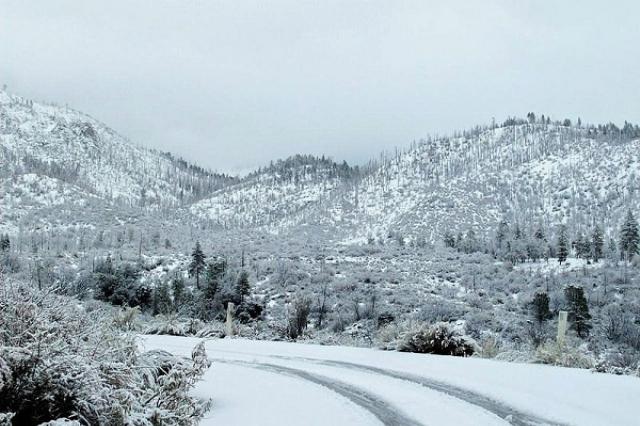
Image: Zink Dawg via Wikimedia Commons, CC BY 3.0.

FOLLOW US ON


