



 Print
PrintThe Roots of Zohran Mamdani’s Rage
In today’s political landscape, few figures embody the fusion of imported radicalism and homegrown extremism more vividly than Zohran Mamdani.
His rise is not an isolated phenomenon. It’s the product of a layered history that stretches from the British Empire’s colonial machinations in East Africa to the ideological battleground of New York City. Understanding his ideological roots reveals not only where this movement came from but where it may be heading.
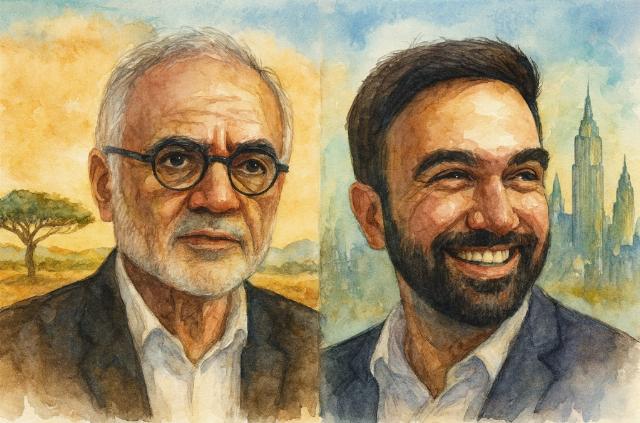
Image created using AI.
The story begins in colonial Uganda, where the British cemented their rule by granting privileged status to Indian merchant communities, including Mamdani’s ancestors. They served as intermediaries between imperial rulers and native Africans, a structure that divided society into privileged urban elites and disenfranchised rural subjects.
Mahmood Mamdani, Zohran’s father, was born in 1946 in Bombay to Gujarati Muslim parents who belonged to this colonial-era trading elite. Raised in Kampala, he grew up surrounded by both the privileges and tensions of this imperial arrangement.
When Uganda gained independence in 1962, the colonial system’s ethnic hierarchies persisted, laying the groundwork for instability. A decade later, this tension exploded when Idi Amin expelled 80,000 Asians, including the Mamdani family, confiscating their property and forcing them into exile.
In 1973, Mahmood chronicled this experience in his memoir From Citizen to Refugee, portraying the expulsion as both traumatic and historically inevitable—a reckoning with the legacy of colonial intermediaries. The family’s displacement became a defining element of its identity, planting seeds of grievance and radical critique that would shape future generations.
Mahmood Mamdani responded to exile not by retreating but by turning his experience into a sustained critique of Western civilization. He returned to Uganda in 1986 to challenge “Eurocentric” academic structures, working to dismantle what he viewed as lingering colonial intellectual dominance.
Zohran was born in Kampala in 1991 into a household steeped in anti-colonial discourse, his middle name honoring Kwame Nkrumah, the pan-African revolutionary.
In 1996, Mahmood published Citizen and Subject, a purported analysis of how indirect colonial rule created enduring authoritarianism. His argument that the empire’s methods, not indigenous cultures, were responsible for postcolonial despotism became a cornerstone of radical postcolonial thought.
Five years later, at a Nobel Symposium, he connected ethnic violence across Africa directly to British divide-and-rule strategies, calling for revolutionary reexaminations of political structures rather than reliance on Western human rights frameworks.
By 2022, Mahmood had taken these ideas further, equating Abraham Lincoln’s Civil War policies with Adolf Hitler’s inspirations, portraying America as the progenitor of genocidal regimes. These views, nurtured in elite academic circles, were not fringe. They became intellectual fuel for a younger generation raised to see Western civilization not as liberator but as oppressor.
Zohran’s upbringing reinforced this worldview. His parents embody different diasporas. Mahmood, of course, is an Indian Muslim-slash-Ugandan exile, while his wife is a Hindu Punjabi who has lived in multiple countries. For Zohran, who was raised in his father’s religion, this created an aggressively transnational identity, necessitating a hybrid self-perception that floats between quite different cultures.
Born amid Uganda’s postcolonial turbulence, he was raised in South Africa during the fraught post-apartheid years. By age seven, the family settled in Manhattan. There, Zohran’s father found work at Columbia University. His mother later said her son “isn’t American at all—he’s at home in many places with different identities.”
This rootlessness carries political implications. It made him particularly receptive to ideologies that prioritize global grievance over national belonging. His early life trained him to see identity as fluid and Western power structures as inherently oppressive. Needless to say, that is a mindset fertile for the radical left’s worldview.
Once in the United States, Mamdani encountered a political culture already transformed by decades of immigration and ideological importation. The 1965 Hart-Celler Act had dismantled the national-origins system, opening the door to massive waves of newcomers from postcolonial societies.
By 1980, over 14 million foreign-born residents had reshaped America’s demographic and ideological terrain, bringing with them grievances that aligned with redistributionist and identity-based politics. Over the decades, these patterns embedded postcolonial leftism into America’s institutions, with 88 percent of future population growth driven by immigrant-descended groups steeped in these narratives.
Zohran entered this environment as both product and amplifier of this shift. In 2009, his Columbia University application identified him under multiple racial categories, exploiting affirmative action systems designed to favor minorities over merit. At Bowdoin College, he published pieces denouncing “white privilege” as systemic evil, framing America itself as an oppressive structure.
He also dipped into Islamist sympathies. In 2017, a rap song he released referenced the “Holy Land Five,” convicted Hamas financiers, portraying them as victims of injustice.
By 2018, as a newly naturalized citizen, he joined the Democratic Socialists of America, embracing a program that merges classic Marxian redistribution with intersectional, or woke, identity politics. This blend reflects his family legacy: an anti-colonial critique repurposed to attack American capitalism and national identity.
Mamdani’s political career exploded in 2020 when he won a New York State Assembly seat by harnessing identity politics and anti-police rhetoric, calling the NYPD “racist” and a “threat to public safety.”
Once elected, he advanced legislation targeting Jewish nonprofits that support Israel, attempting to choke off aid to America’s key Middle Eastern ally. He later staged a hunger strike, portraying Israel’s self-defense as “genocide.” In 2024, he mocked Hanukkah traditions, signaling contempt for core Jewish practices.
His 2025 mayoral campaign escalated this radicalism. He proposed higher property taxes on “richer and whiter neighborhoods,” weaponizing race to justify redistribution. He refused to condemn chants of “globalize the intifada,” dismissing concerns about their violent implications. When pressed on Hamas disarmament, he evaded, prioritizing vague notions of “justice” over condemning terror. Perhaps most revealing was his appearance alongside Imam Siraj Wahhaj, an unindicted co-conspirator in the 1993 World Trade Center bombing, proudly describing their meeting as a “beautiful Jummah.”
Mamdani personifies an alliance between rising Democratic socialism and radical Islamism. His ascent is inseparable from America’s demographic and ideological transformation since the mid-20th century. The country opened its doors to millions shaped by bad colonial blood, then built institutions that absorbed and amplified their critiques. Those critiques, once directed at empires overseas, now target America herself.
The result is a political movement that merges Marxian economic redistribution with postcolonial resentment and woke, intersectional grievance. It attacks the pillars of Western civilization while allying with Islamist elements that share its hostility toward the traditional democratic order.
This is not the American left of union halls and, later, social liberalism. It is a borderless ideological project, nurtured in the lecture halls of postcolonial theorists, sharpened in the crucible of identity politics, and unleashed on the streets of America’s cities. Zohran Mamdani stands as both a symbol and strategist of this new movement, proving that imported radicalism can take root, merge with domestic extremism, and grow into a formidable political force.
Understanding his background is not about a personal attack. It’s about recognizing the forces reshaping American politics. His story connects colonial Uganda, Ivy League seminars, and Brooklyn mosques in a single narrative arc. It shows how ideas born in the wreckage of empire can be repurposed to corrode America from within.
And that, more than any single policy proposal, is what makes this movement so dangerous.
Dr. Joseph Ford Cotto is the creator, host, and producer of News Sight, delivering sharp insights on the news that shapes everyday life. He also provides affordable, results-driven consulting for business, management, media, politics, and the economy. During the 2024 presidential race, he developed the Five-Point Forecast, which accurately predicted Donald Trump’s national victory and correctly called every swing state. Cotto holds a doctorate in business administration and is a Lean Six Sigma Certified Black Belt.
FOLLOW US ON


