



 Print
PrintRussia’s Nuclear Strength Rests Atop Systemic Weaknesses
There’s not a nation on Earth that works as hard to ensure its perception of invulnerability as Russia does. Russia projects a narrative that its ascendancy is inevitable, while the reality is the opposite. You never see Russia panic publicly, but the signs that they are under tremendous stress can be seen everywhere if you look even just a little underneath the facade.
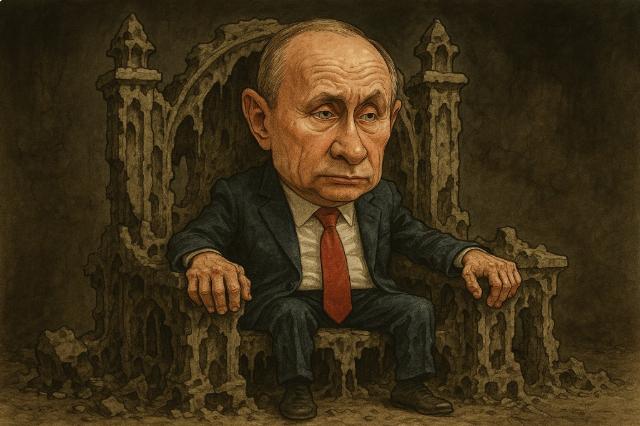
Image created using AI.
Power in Russia today is concentrated in a personalized, centralized, highly vertical power structure dominated by Putin and a narrow circle of security-service and loyalist elites who control political appointments, major economic assets, and coercive instruments of the State. This is essentially unchanged from Soviet days, except previously we called them communists, while today Russia is effectively a dictatorship with democratic embellishments.
Russia’s national policy has always been expansionist. Russian leaders for centuries have believed that this policy advances Russia’s national interest. Because it views its existence as dependent on growth, it believes any efforts to stifle that growth threaten its existence. For Putin, whose vision is of an expansive Russian empire that has no territorial limitations, the world is his enemy.
Going into this battle, Russia has one distinct strength, which is its nuclear power. It maintains a nuclear triad roughly equal in size to the American arsenal. Russia has heavily leveraged that truth by regularly threatening the probability that, if deterred from its aims, we risk a nuclear Armageddon. The West must continuously grapple with this threat as it deals with Putin’s ambitions.
However, Russia also struggles with numerous problems that make it less of a risk in traditional combat.
Russia’s economy is not strong. The entire economy is exhibiting clear signs of instability driven by shrinking energy revenues (a burden Trump has placed upon it), heavy reallocation of public spending toward the military, mounting budget deficits, high interest rates, and labor shortages from mobilization and emigration, leaving civilian sectors stagnating.
Russia’s population is 146 million vs. 335 million here. Russia’s GDP is 2.2 trillion dollars, compared to 29.2 trillion in America. That’s not a typo! A revealing fact is that 22.6% of Russians do not have indoor bathrooms.
And while Russia doesn’t have a violent crime problem, it has a very serious organized crime problem that affects its economic well-being because it’s a constituent slice of Russia’s legal and illegal markets. The Russian government also partners with organized crime to intimidate and control the population.
The oligarchs have significant and damaging power. Contrary to what Sanders and AOC State, we have no oligarchs in America. However, in Russia, oligarchs exchange economic resources, political loyalty, and governance support for protection, access, and preferential treatment from the state. The Kremlin enforces a clear bargain: wealth and limited autonomy in return for staying out of overt politics and performing “favors” on demand; there is no parallel to that in the West.
Ukraine itself has become a serious burden. It’s a costly, entrenched, and politically binding conflict that drains resources, erodes international standing, and narrows strategic options while producing recurring military, economic, and political blowback. Ukraine has become Russia’s Sticky Tar Baby.
Given these problems, a range of plausible destabilizing scenarios could unseat Putin by combining elite defection, mass social unrest, coercive state fracturing, economic collapse, or external military shock; each pathway involves interacting political, military, financial, and personal-security dynamics rather than a single tipping point.
A prolonged, “forever” war materially increases the probability of destabilizing scenarios for Russia by amplifying fiscal, demographic, military, and elite stresses that can combine to produce elite defections, mass unrest, or institutional breakdown over medium to long time horizons.
Over the medium term of 1-3 years, Russia faces a 15%–35% chance of a destabilizing scenario that could lead to significant elite reconfiguration, managed removal, or large-scale unrest that forces political change. Over a longer term of more than three years, the chances rise to 40-70% according to sources.
Russia is unquestionably a nuclear threat. However, it’s also a pipsqueak nation with grandiose ambitions. We cannot ignore or discount a nuclear Russia, but we cannot surrender to her either. Russia is demonstrably a bully and an aggressor, so appeasement is not an option. Russia’s Achilles’ Heel is time. In very much the same way as the Battle of the Bulge played out, German forces ultimately saw their advance grind to a halt once resources were depleted.
Realistically, every day, Russia’s options contract, not expand. Its alliances are at best fixed. Russia’s propaganda machine primarily targets fickle, yet malleable public opinion, much less effective with heads of State or those in the know. Opposition forces in Ukraine and the rest of the Western world absorb the existential threat that Russia embodies, reinforcing an understanding that a Russian victory in Ukraine ultimately leads to a threat against Eastern Europe.
Donald Trump has done something remarkable yet again. While espousing an American First outlook, he has done what is necessary to mobilize Europe to defend itself, something nobody could have seen coming a few short years ago. If that were not an accomplishment enough, he has found an acceptable way to have the United States backstop Ukraine without a massive influx of American dollars. Truly a remarkable achievement.
God Bless America!
Author, Businessman, Thinker, and Strategist. Read more about Allan, his background, and his ideas to create a better tomorrow at www.1plus1equals2.com.
FOLLOW US ON


