



 Print
PrintDecolonizing America from Sea to Shining Sea
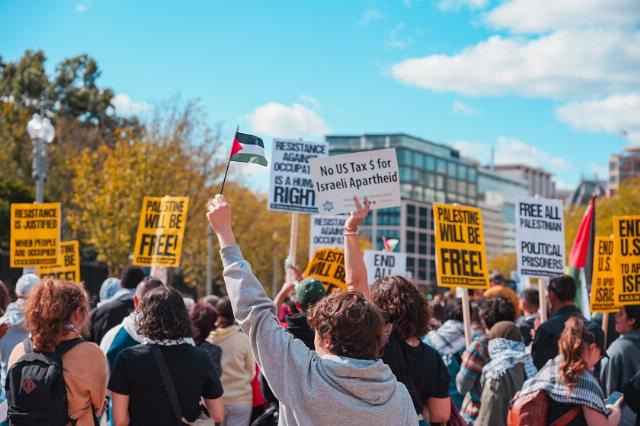
It will take more than the physical reconstruction of Gaza to establish a lasting peace. The rebuilt schools and universities will have to teach cooperation and development rather than hatred and suicidal violence. Former Israeli hostage Tal Shoham revealed that high school and college faculty members were among the Hamas terrorists. No surprise there, and no surprise that the pro-Hamas demonstrations in America were mostly campus based. There is within academe an ideology that rejects the legitimacy of both Israel “from the river to the sea” and the U.S. “from sea to shining sea” on highly subjective moral grounds as “settler colonies” that should never have come into existence.
Most Americans had probably never heard the term “settler colonialism” before its use by opponents of Israel’s military retaliation for the terrorist attacks of October 7, 2023. When protests called for the end of Israeli “occupation” if was not from Gaza. Israel withdrew from Gaza in 2005, having no desire to rule over a people so different from its own. Two years later, Hamas seized control of Gaza. The “occupation” being decried was of all alleged Palestinian land meaning Israel itself. Hamas’s attack into Israel was not to liberate Gaza, but to destroy Israel or as many of its people as possible. To critics of “settler colonialism” Hamas’s attack was legitimate because of its revanchist motive.
This heated rhetoric is not just from street activists and fringe academics. Columbia University economics professor Jeffrey Sachs has a list of establishment awards a mile long. He is both the Director of Columbia’s Center for Sustainable Development and president of the United Nations Sustainable Development Solutions Network. Writing less than two weeks after the Oct. 7 terrorist attack, he argued ‘The affirmation of Israeli acts of genocidal violence as self-defense is not only a grotesque distortion. It points to a social truth: that the social form of the American settler state foments an identification with settler ways of being -- with white settler life and social existence.” The title of his article was “The struggle against settler colonial affinities.”
Despite Hamas’ core objective of destroying Israel, Sachs turned the issue around to Israel’s alleged desire to destroy Palestine. He claimed, “Among the truths that have become clear in the days following Hamas’s October 7 attack against the Zionist Israeli state is that the globally sanctioned institutions of legality and stately life abhor Palestinian existence and collaborate to bring about the end of Palestinian life.” No wonder Columbia saw some of the most violent protests against Israel’s actions and very existence. Yet, Israel has worked with Palestinian groups that want liberation from the Hamas death cult, groups that will be essential for implementing the massive rebuilding projects (inspired by “the thriving modern miracle cities in the Middle East”) outlined in the 20-point peace plan orchestrated by President Donald Trump. Tragically, the failure to immediately deploy international security forces upon the signing of the peace agreement has allowed Hamas to attack and kill Palestinians who favor peace and development.
But to return to the ideological underpinning of the antipathy towards Israel, America, and Western civilization in general, what are “settler ways of being” to which the Left objects? It is nothing less than the desire for material progress which makes capitalism attractive and breeds expansionist ambitions conducted by violent conquest and the displacement of less developed “indigenous people” from contested territory. As Leigh Patel, a professor of education at the University of Pittsburgh has written in her monograph No Study Without Struggle: Confronting Settler Colonialism in High Education, “Settlers must always be settling land and turning it into property. Indigenous people must always be disappearing” and “Every single social and political space of the United States has been deeply shaped by the history and structure of empire and colonialism.” It is the “linear history of how the United States became a great power.”
 Most Americans know this history and enjoy living in the advanced, affluent country it created just as the Founders intended. Ben Franklin observed even before the colonies made their bid for independence from the British Empire, “I believe people increase faster by generation in these colonies, where all can have full employ and there be room and business for millions yet unborn.” He believed in westward expansion to make the continent a “populous and powerful dominion” within a century, and he was prophetic in this. It was not the cavalry that won the West, it was demographics, as people rushed to America as the “land of opportunity,” building cities, factories, farms, ranches, and all the infrastructure, technology, and social networks of modern life. A process that continues as the desire for improvement has not waned. Canadian historian Mark Egnal has persuasively argued that a major motive for the American Revolution was that those with the drive to be settler colonialists (though he doesn’t use that term) chaffed under a London government that did not sufficiently support their desire for continental expansion. He quotes Henry Laurens, the second president of the Continental Congress, who claimed “A mighty empire… will arise on this continent when she [Great Britain] cannot hinder its progress.”
It is the undoubted success of the United States (as well as the other settler colonial states of Australia, Canada, New Zealand, and Israel) that poses a problem that the Left cannot answer without dismissing the very idea of progress as a good thing. Their ideology has had nothing to do with success anywhere in the world. Even China, where once Mao Zedong was the global champion of the leftist utopia (see Julia Lovell’s Maoism: A Global History), adopted a version of capitalism after the collapse of the Soviet Union and now boasts of having almost as many billionaires as in America. So, the Left now champions the “indigenous people” whose very primitive status when “discovered” by the settler colonialists is now hailed as demonstrating superior moral virtue. It is easy to see how this ideology of failure so easily blends into the Green movement which rejects economic growth as dangerous. Returning to Columbia University, during its 2022 Climate Week, its Climate School published an article entitled “How Colonialism Spawned and Continues to Exacerbate the Climate Crisis.”
The roots of this “noble savage” idea go back to the Swiss-French radical Jean-Jacques Rousseau as I examined in a previous column.
One thing is certain, the leftist claim that pre-civilized people were pacifists living in harmony with nature and each other until corrupted and/or forced to resist settler colonialism is false. As military historian Wayne E. Lee has states in Waging War: Conflict, Culture and Innovation in World History (a book that should be in the library of anyone who wants to hold a serious opinion on the topic) “The basic contention here is that coordinated lethal conflict between groups of humans intent on increasing their access to resources of various types has existed at all times and in all places, but not all the time. Even when not actively occurring, however, the threat affected social development and organization.” Native American tribes waged brutal wars against each other even after the Europeans arrived. And the Islamic faith Hamas claims as its core was spread across the Middle East, Central Asia, North Africa and into the Balkans by armed conquest. Indeed, there is not a square mile of habitable land that has not been fought over time and again.
The world advances when its most civilized powers are expanding rather than its barbarians. In 1820, two-thirds of humanity lived in extreme poverty, today it is down to ten percent due to the growth spearheaded by the West. We should all be thankful that America is the result of Benjamin Franklin’s settlers and not the hordes of Genghis Khan. And proper scholarship should focus on how to keep us on top.
William R. Hawkins is a former economics professor who has worked for several Washington think tanks and on the staff of the U.S. House Foreign Affairs Committee. He has written widely on international economics and national security issues for both professional and popular publications including for the Army War College, the U.S. Naval Institute, and the National Defense University, among others.
Image: Ted Eytan
FOLLOW US ON


