



 Print
PrintAl-Andalus: The Stubborn Myth of Tolerance
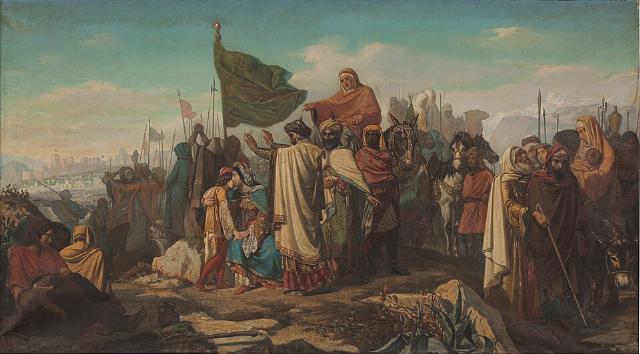
From Wikimedia Commons: The sigh of the Moor (Benito Soriano Murillo, 1856)
.jpg)
Rather than “harmony”, the period of Muslim rule in the Iberian Peninsula (711–1492) was characterized by strained relations between Christians, Muslims, and Jews. While the Muslim conquerors of “al-Andalus”, as they named the territory, did allow indigenous Christians to go on practicing their own faith, this supposed gesture of “tolerance” — embellished, of course, by Marxist apologists at Western universities — was in fact severely attenuated by social, legal, and political regulations.
After the Muslim conquest got going in 711, Visigothic Christians faced the choice between converting to Islam and staying in the church, with the latter option being at the cost of equal rights as an ordinary citizen of the caliphate. If unwilling to abandon the faith of their ancestors, they were subjected to the “dhimmi” (proto-apartheid) system. The status of dhimmi, “protected but subordinate”, entailed public humiliation. Altogether, dhimmi regulations created a climate of “systemic and structural” discrimination, pressuring Christians towards conversion to Islam for socio-economic relief.
Few periods in European history have inspired such divergent interpretations as that of al-Andalus — the centuries of Muslim rule in Iberia, from the early 8th century until the fall of Granada in 1492. The topic is ideologically charged in our time as large parts of Western Europe are changing profoundly under pressure from migrant masses from the Middle East, Asia, and North Africa. For some, al-Andalus represents a “golden age of tolerance, multicultural harmony, and intellectual brilliance”. For others, it was a time of unmitigated oppression, cultural domination, and bouts of Christian (non-Muslim) persecution.
As with most historical periods, the truth of the matter may not necessarily reside in the extremes. With this caveat, however, we are failing justice through relativistic narratives that (a) trivialize the non-Muslim persecution and arbitrary sadism under Muslim rule, (b) deny the ideological motives behind those crimes without further ado, and (c) ignore the plight of Christian victims — all for the sake of “peace in our time”. The truth is undoubtedly to be found in a complex interplay of both barbarism and brilliance, oppression and flourishing. Hence, a critical examination of al-Andalus must consider the tyrannical mechanisms of religious rule alongside the cultural and artistic achievements that left a lasting legacy in European civilization.
In the West, thanks to Marxist indoctrination in educational institutions, we cultivate “tolerance” to the point of destroying ourselves. However, we also like to imagine that our deadliest enemies are actually tolerant and well-meaning. It is a version of the “universalist delusion” that we all share the same values deep down. Embracing a genuinely “anti-aggressive” approach, we prefer to blame ourselves for intolerance rather than find fault with the enemy who openly threatens us. This flawed, fundamentally cowardly mindset is at the root of Europe’s ongoing suicide as a part of Western civilization.
The idea of “convivencia” — peaceful coexistence between Muslims, Christians, and Jews — is central to the romanticized image of al-Andalus. Proponents of this view emphasize that under Muslim rule, especially during the Umayyad Caliphate in Córdoba (10th century), Iberia saw an unprecedented flourishing of science, philosophy, literature, and architecture. Cities like Córdoba, Seville, and Granada were renowned as centers of learning where Muslim, Jewish, and Christian scholars translated ancient texts, debated theology and philosophy, and advanced mathematics, astronomy, and medicine.
Jewish philosopher Maimonides, born in Córdoba, is frequently cited as a symbol of an openminded, intellectual community. Jewish courtiers like Hasdai ibn Shaprut served as physicians and diplomats in the caliphal courts. Although second-class citizens, Christians fended for themselves, adapting to the customs of the Arab conquerors while remaining Christian by faith — known as “Mozarabs”.
This vision of a tolerant and enlightened al-Andalus has served modern ideological purposes, as when contrasted with the vengeful violence of the Reconquista and the Spanish Inquisition that followed. In the 20th century, scholars such as María Rosa Menocal, Sterling Professor of Humanities at Yale University, presented al-Andalus as a model of multicultural harmony, a lost paradise of rationalism and tolerance in an otherwise intolerant medieval Europe.
Yet this image is severely incomplete and manipulated. While there were periods of relative tolerance, non-Muslims lived under dhimmitude — a legal status that allowed them to practice their faith, but branded them as second-class citizens. Under Islamic law, dhimmis were required to pay the “jizya” tax (selectively imposed on non-Muslims) and barred from holding high political office, building new churches, openly or publicly displaying Christian symbols, testifying against Muslims, bearing arms, and proselytizing.
At times, the master-slave arrangement was pragmatic and stable. Having to survive, Christians adapted to the conditions imposed on them by their masters as best they could. However, at other times, non-Muslim communities were subjected to random persecution, forced conversions, and savagery. The so-called “Martyrs of Córdoba” in the 9th century — 48 Christians who were executed for publicly denouncing Islam — reveal that religious dissent under Muslim rule could lead to death. Far from isolated anomalies, violent episodes were part of a broader reality: a theocratic system that privileged Islam and oppressed other faiths whenever political or religious zeal demanded it.
Likewise, the Granada Massacre of 1066, in which thousands of Jews were killed by a Muslim mob, starkly contradicts the narrative of harmony. In the 12th century, the Almohad dynasty, which came to power in North Africa and extended its control into al-Andalus, imposed a strict fundamentalist reading of Islam. Under the Almohads, both Jews and Christians were ordered to convert, flee or face death — circumstances that forced Maimonides and his family into exile. Many Christians also fled north in the hope of settling in the mountainous Christian kingdoms or simply practiced their faith in secret to avoid persecution.
Throughout this period, the extensive destruction or conversion of churches into mosques was a symbolic and practical form of oppression, limiting Christian public worship and visibility. While non-Muslim persecution varied in severity, depending on the ruler and period, it consistently reflected the precarious position of Christians under Muslim rule.
Notwithstanding the injustices to non-Muslims, al-Andalus is known to have produced exquisite pieces of architecture, including gardens. The Great Mosque of Córdoba, the Alhambra palace in Granada, and the Giralda in Seville are testaments to a sophisticated aesthetic sensibility and advanced engineering. These buildings, with their intricate arabesques, muqarnas ceilings, and geometric tilework, reflect a fusion of Islamic, Christian, and local Iberian styles.
As to academic production, Andalusian philosophers such as Averroes (Ibn Rushd) played a key role in preserving and commenting on the works of Aristotle, which would later influence Christian scholasticism in Europe. Muslim polymaths such as Al-Zahrawi advanced surgical techniques, while astronomers like Al-Zarqali (Arzachel) improved celestial models that informed later European science.
These achievements emerged within a hierarchical society that, while oppressive, allowed enough space for cultural ingenuity and intellectual inquiry to thrive. This contradiction — cultural flourishing amid religious subordination — defines the Andalusian legacy in essence.
Echoes of the 8th century Islamic conquest of Visigothic Iberia may still be heard. In modern times, al-Andalus has taken on symbolic importance far beyond its historical boundaries. For some Islamist or pan-Islamic movements, it represents a “lost” Islamic land that must be spiritually or politically reclaimed. Salafist-jihadist groups such as ISIS have invoked the memory of al-Andalus in their propaganda, portraying it as “stolen Muslim territory”.
In contrast, Western liberal intellectuals, afraid of criticizing anybody other than their own countrymen, which is relatively safe, have idealized al-Andalus as a counterpoint to contemporary religious intolerance, using it to critique both modern “Islamophobia” and “Western chauvinism”. Both approaches, however, tend to instrumentalize history, projecting modern political agendas onto a deeply complex and contradictory past.
Al-Andalus was less a “utopia of interfaith harmony” than a “dystopia of religious tyranny”. To be fair, a historical coincidence of fortunate circumstances gave both science and artistic pursuit the opportunity to shine despite autocracy, religious supremacism, and violent excesses. Recognizing this duality is essential for truly understanding the past and resisting simplistic historical narratives in the present.
Rather than nostalgia or grievance, the enduring fascination with al-Andalus should inspire critical reflection on the possibilities and limits of coexistence in diverse societies, both medieval and modern.
Westerners must finally decide between freedom and slavery.
FOLLOW US ON


