



 Print
PrintCross-Regional Analysis of Renewable and Dispatchable Energy Sources
The effect of over two decades of preferential government treatment for wind and solar energy is observable throughout the world. The mix of renewables has been optimized to match each region’s relative abundance or scarcity of renewable resources. In each case, we can assume that engineers have diligently designed and implemented functioning systems based on the constraints imposed by governmental mandates, available renewable resources, and costs of capital, operations, and fuel. By comparing commonality and difference in the electrical capacity and generation across regions, one can draw certain conclusions about the impact of renewables on systems worldwide.
Before we start with the comparison, it is best to categorize the constituent parts of the system that we will be investigating. Traditionally, there have been two broad categories of power generation: baseload and dispatchable. Baseload power is steady state with a slow ability to ramp up and down. It does not respond quickly enough to fluctuations in demand. In fact, it is optimized to have high thermal efficiency and utilization as indicated by its capacity factor. The capacity factor is a measure of how effectively a power plant is operating compared to its maximum potential output over a specific period (Capacity Factor = Actual Output / Maximum Possible Output).
On the other hand, dispatchable power has a transient characteristic with a relatively fast response time that can follow variations in demand. Dispatchable generation is not optimized for high thermal efficiency or utilization and, as such, is more costly to operate. With the advent of renewables, there enters a third category: intermittent power. As with variations in demand, dispatchable power must be employed to compensate for the intermittency of renewables. Stored energy, such as pumped hydroelectric and batteries, is dispatchable power also. However, in practice, most dispatchable power comes from natural gas-driven thermal power plants. Therefore, it is practical to view renewables, wind, and solar, as operating in concert with dispatchable natural gas. Together they comprise the residual component that fills in the gap between baseload power and demand. I have decided to focus my attention on it.
For my study, I have chosen four regions: the U.K., Spain, Texas, and California. I have chosen them because of their diversity. The U.K. and Spain pay a relatively high price for natural gas compared to Texas and California (see Figure 1).

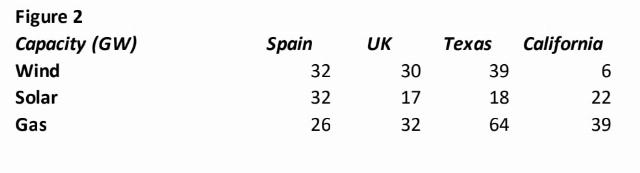
All have chosen a specific mix of renewables that best suits them. Spain, the U.K., and Texas have invested heavily in wind power. Spain has installed significantly more solar power capacity than the others (see Figure 2).
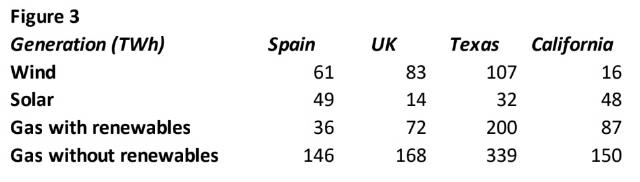
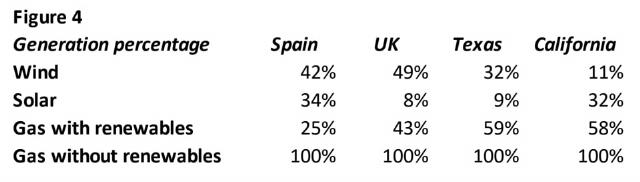
The generation they derive reflects the investment each made in capacity. However, the relatively low solar generation in the U.K. is due to its high latitude (see Figure 3 & 4).
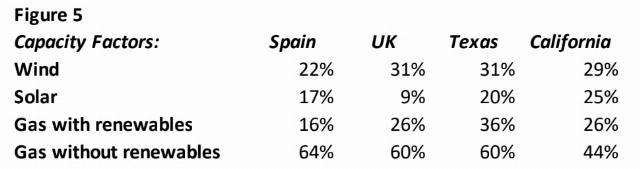
The most telling statistics are the capacity factors. The capacity factors for wind, solar, and natural gas, operating in concert, are quite low in comparison to natural gas running solo (see Figure 5). In essence, there are three underutilized assets (wind, solar, gas) doing the job that one asset (gas) could perform more efficiently.
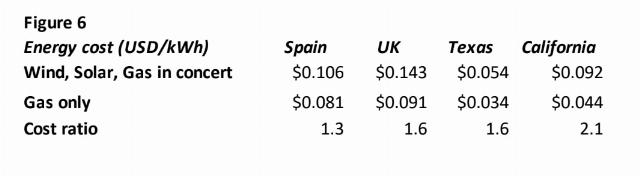
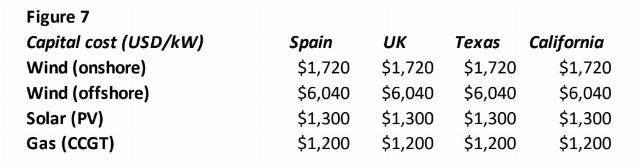
Comparing the cost of those three expensive, underutilized assets per kWh generated against the cost of one fully utilized asset (with the additional fuel cost) per kWh generated, one sees that the current mixed systems in every region are more expensive than the gas-only option (see Figure 6). Capital cost estimates for each asset are from EIA (see Figure 7).
My calculations are here for all to review. This should destroy the myth, propagated by many, that renewables are the cheapest form of energy.
FOLLOW US ON


