

 Print
PrintTrump’s Ukraine Ultimatum: A Promising First Step
President Trump’s July 14 ultimatum to Vladimir Putin—demanding peace in Ukraine within 50 days and threatening secondary sanctions on countries like China and India if they continue funding Russia’s aggression—is a welcome and long-overdue step. But it is just that: a first step. If the goal is peace and deterrence of future wars, the United States and its allies must go further.
Our goals should include upholding the Rule of Law. And the law governing Putin’s blatant international aggression is clear, as is the appropriate punishment. In April 1927, French Foreign Minister Aristide Briand proposed a U.S.-France bilateral treaty renouncing war between them. Secretary of State Frank Kellogg countered that they should persuade the entire world to outlaw war. And on August 27, 1928, at a Paris peace conference, virtually the entire world agreed.
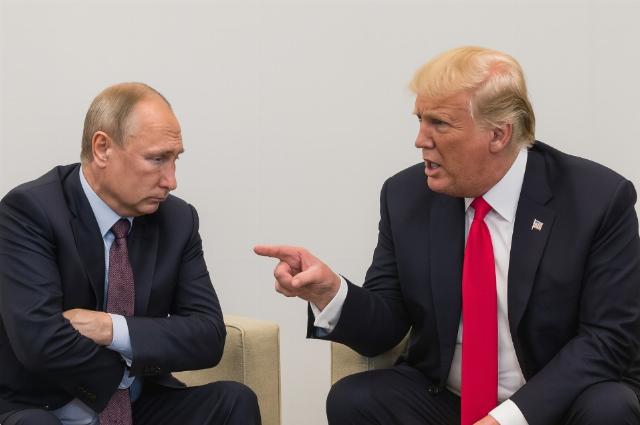
Image created using ChatGPT.
Indeed, the Soviet Union ratified the Kellogg-Briand Treaty even before the United States, and only a single U.S. senator voted against granting “advice and consent” to ratification. For his leadership role in outlawing aggressive war, Kellogg received the 1929 Nobel Peace Prize. But when Adolf Hitler threatened world peace, the “America First” movement pressured Congress to enact a variety of “war powers” and “neutrality” acts limiting America’s ability to assist victims of Nazi aggression, reinforcing the message to Hitler that the world community was not serious about opposing aggression.
In 1945, the United States invited nations from around the world to San Francisco to again renounce war and create an international organization to preserve the peace. Article 1(1) of the United Nations Charter establishes as its primary purpose: “To maintain international peace and security, and to that end: to take effective collective measures for the prevention and removal of threats to the peace, and for the suppression of acts of aggression or other breaches of the peace...” Thus, it does not matter whether Ukraine is a member of NATO. The entire world has committed itself by solemn treaty to act collectively to end Putin’s aggression.
The parallels between Vladimir Putin’s blatant international aggression against Ukraine and Adolf Hitler’s justification for the start of World War II are striking. Hitler noted that the Czechoslovakian Sudetenland had once been a part of Germany, and most of its inhabitants spoke German. Similarly, Putin argues Ukraine was once part of the Soviet empire, and many of its residents speak Russian. Again mimicking Hitler, Putin falsely alleges that Ukraine was persecuting it’s ethnic Russian minority.
Article 2(4) of the Charter provides: “All Members shall refrain in their international relations from the threat or use of force against the territorial integrity or political independence of any State, or in any other manner inconsistent with the Purposes of the United Nations.” There are no “shared language” or “prior association” exceptions. Secretary of State Cordell Hull received the 1945 Nobel Peace Prize for his role in establishing the UN. (Article 2[4] also prohibits “threats” to invade Greenland or Panama. The United States also has a legal duty under the 1949 Geneva Conventions to prosecute or extradite accused war criminals.)
All 193 territories that clearly qualify as sovereign States are now UN members. Article VI, Clause 2, of the U.S. Constitution declares that, along with the Constitution and laws made pursuant to it, “Treaties…shall be the supreme Law of the Land,” and Article II, Section 3, requires the president to “take Care that the Laws be faithfully executed.”
The appropriate punishment for aggressive war is equally clear and was first established at the 1945 London Conference that set the parameters for the Nuremberg International Military Tribunal that began the following year. More than a dozen Nazi and Imperial Japanese leaders were hanged as war criminals after being convicted for their roles in World War II aggression.
Indeed, it was at the insistence of the Soviet judge—with the strong concurrence of future U.S. Supreme Court Justice Robert Jackson, the American prosecutor—that the London Conference listed first among war crimes to be tried, “Crimes Against Peace: namely, planning, preparation, initiation or waging of a war of aggression, or a war in violation of international treaties...”
None of Putin’s alleged justifications for his aggression pass the straight face test any more than did Hitler’s false 1939 claim that Poland had attacked Germany. And every country in the world acknowledges that international law is legally binding (and not just “guidelines”—as in the “Pirates of the Caribbean” pirate’s code or the assertions of Trump’s former National Security Adviser John Bolton).
Here are four specific actions President Trump might wish to consider:
- Privately warn Putin against escalation. The 50-day window should be clearly conditioned upon Russia refraining from new offensives. Unless Trump wants to provoke a final land grab, Putin must understand the 50-day clock will expire immediately and the new sanctions will take effect if Russia launches another offensive.
- Make the consequences unmistakable and painful to Putin himself. Privately inform Putin that if he does not announce and begin a complete withdrawal from Ukraine by Trump’s deadline, new primary (including no Russian participation in any international competitions like sports or chess unless competitors defect and compete for other countries) and secondary sanctions will go into effect—and they will remain in effect until all aggression ends, pre-2014 borders are restored, and Putin himself is either dead or in the custody of an appropriate international tribunal to be prosecuted for his war crimes. Putin must understand that continued aggression means personal accountability under international law in accordance with the position championed by the Soviet Union at the 1945 London Conference. If we want to deter future aggression, allowing other potential aggressors to witness Putin hang (or just spend the rest of his life in a cage) will send a useful message: They would be wiser to play golf!
- Coordinate with NATO and key economic allies. A united front matters. If China, India, and others are forced to choose between buying Putin’s oil and access to NATO’s $50 trillion economy—which is 25 times larger than Russia’s—they will be unlikely to continue aiding Putin. And, having pressured our NATO allies to agree to spend 5% of their GNP on defense programs, the United States should do the same.
- Send a message to North Korea. Kim Jong Un’s deployment of more than 10,000 troops to aid Putin constitutes direct participation in a war of aggression. Under Article 51 of the UN Charter, Ukraine may request military assistance from every UN member. Kim should understand that this makes him individually—a legal point I addressed 35 years ago—and his regime legitimate targets for lethal force by every country. If Kim continues his aggression and it becomes necessary to send B-2 stealth bombers to Osan Air Base in South Korea armed with 30,000-pound GBU-57 Massive Ordnance Penetrator (MOP) bombs (like those used recently in Iran), sleeping in underground reinforced concrete bunkers will not be an impediment to regime change. And since South Korea has roughly twice the population of the North, internationally supervised reunification elections would produce a free and democratic Korea that by itself would be worthy of a Nobel Peace Prize.
In summary, Putin’s invasion of Ukraine is a test of whether international law still holds meaning in the 21st century. If the world fails to enforce the prohibition against territorial conquest, the consequences could be catastrophic. More than 50 million lives were lost when appeasement sparked WWII. A nuclear World War III would be worse.
President Trump has an opportunity. If he can successfully lead a global coalition that halts Russian aggression, he may well be remembered as a transformative foreign policy leader—the 21st century’s “Winston Churchill.” (Ironically, a month ago, I would have wagered that Trump’s legacy would be as the modern “Neville Chamberlain,” given his apparent fear of Putin and disgusting efforts to attribute Russian aggression to Ukraine.) A courageous Trump would likely also win the Nobel Peace Prize he has long coveted.
The choice given to Putin should be clear and simple: Withdraw completely now, or face the full consequences of the law from a united world. Cease your aggression immediately and withdraw all your forces from Ukraine, or face the probability of being hanged as a war criminal—or, if you are very lucky, spending the rest of your life in a prison cage.
Prof. Robert F. Turner served as the first president of the congressionally established United States Institute of Peace during the Reagan administration. He later co-taught an interdisciplinary postgraduate seminar on “New Thinking About War and War Avoidance“ at the University of Virginia for two decades prior to his 2020 retirement.
FOLLOW US ON


