

 Print
PrintMay 21, 2009
American Idol: Underdogma Strikes Again
For the second year in a row, American Idol voters have chosen the underdog over the frontrunner.
Viewers, odds makers, pundits, more than half the audience - even Simon Cowell - were all stunned when the seemingly untouchable frontrunner fell to the underdog. Again.
They shouldn't have been surprised. Rooting for the underdog is what American Idol - and what much of our public discourse - is all about.
In any given week, more people tune in to watch amateur underdogs sing (often poorly) on American Idol than buy the Top Ten albums on Billboard's Chart - combined. It seems Americans love underdogs more than superstars.
Superstar Adam Lambert fell to underdog Kris Allen just like superstar David Archuleta fell to underdog David Cook last year. In both cases, a late surge of popular support helped vault the underdog over the more powerful frontrunner.
Rooting for the underdog is nothing new. David versus Goliath, the American Revolutionaries, ‘The Little Engine That Could,' Team USA's ‘Miracle on Ice,' the Star Wars Rebel Alliance, Rocky Balboa, the Jamaican bobsled team and the meek inheriting the Earth -- everyone, it seems, loves an underdog.
Why is that?
Each of us was born, which means each of us enters this world as a small and powerless underdog -- helpless to even feed ourselves -- and surrounded by bigger, more powerful overdogs. In school, we face teachers, principals and bigger, more powerful kids. After that, we emerge into the workforce where we face new Goliaths: bosses and supervisors who interview us, hire us, set our incomes and hold the power to promote or fire us.
The reason we love underdogs is because each of us knows what it feels like to be an underdog, to be a David in a world full of Goliaths.
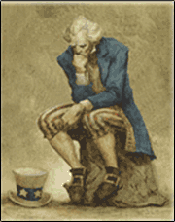
But something else is at play on American Idol. This year and last, millions of people voted against the frontrunner. This is more than simply rooting for the underdog - it is rooting against the overdog. Taken together, these two phenomena are what I call "Underdogma."
Underdogma is the reflexive belief that those who have less power are virtuous and noble - because they have less power, and that those who have more power are to be scorned - because they have more power.
Underdogma has become the most consequential belief system of our time, shaping everything from the outcome of American Idol to the future of America itself.
To see the awesome power of Underdogma, look no further than the White House. Our Commander in Chief is also our Underdogmatist in Chief.
One of the architects of Underdogma was Saul Alinsky, who wrote the seminal Underdogmatist manifesto: RULES FOR RADICALS.
"What follows is for those who want to change the world from what it is to what they believe it should be. The Prince was written by Machiavelli for the Haves on how to hold power. Rules for Radicals is written for the Have-Nots on how to take it away."- "Rules for Radicals" Saul Alinsky, 1971
President Barack Obama was recruited by Alinsky's disciples and followed in his footsteps as a fellow Chicago ‘community organizer.' This reflexive urge side with the weaker underdog and rail against the more powerful overdog is a deep and consistent theme in President Obama's words and deeds.
When the nomination of John Roberts as chief justice of the Supreme Court came up in the Senate in 2005, Sen. Barack Obama argued that the role of a justice is to favor the ‘weak' over the ‘strong.'In justifying his vote against Justice Samuel Alito, Obama said"...I found that in almost every case he consistently sides on behalf of the powerful against the powerless."- "Obama's Class War Court" The Washington Times, March 1, 2008
President Obama has taken every opportunity, both here and abroad, to apologize for American power and for our position as the world's overdog. But he is doing more than just apologizing - he is proactively knocking America down from its overdog perch every chance he gets, and knocking out the foundations that led to America's greatness.
At the heart of the world's most pressing issue - the global economic crisis - evidence of Underdogma is all around us. President Obama and other Underdogmatists tell us this crisis was caused by a "failure of capitalism"[1] with "roots in a long period of global imbalances...turbo-charged by greed out of control."[2] And, all the while, rich, "fat cat" CEOs are being demonized...
"Popular anger puts fat cat CEOs on the run"
- Breitbart.com, September 26, 2008
- Breitbart.com, September 26, 2008
...irresponsible borrowers who didn't pay their bills and triggered the financial crisis are being cast as blameless underdogs..."By 62 - 25 percent, voters blame lenders more than borrowers for the mortgage crisis"- Quinnipiac University national poll, March 4, 2009
...and those who were legislatively coerced into loaning money to those who could not pay it back, under the guise of helping ‘the little guy' buy homes, are now being called greedy and predatory for lending money to poor people:"Stop blaming the working poor for lenders' greed"- MiamiHerald.com, February 27, 2009
"Today President Obama talked about predatory lending as a root cause of the country's financial mess: ‘Banks and lenders must be held accountable..."- CNN, February 18, 2009
How can it be "greedy" to lend money to underdogs who, in turn, don't pay it back? Such is the logic-twisting power of Underdogma.
America was built on a pioneer spirit of achievement and a belief in ‘American Exceptionalism' -- not a reflexive scorn for achievers and a spiteful urge to knock them down. America's unabashed desire to be #1 transformed a once rugged, untamed colony into the greatest, richest, freest, most powerful and culturally vibrant nation in world history.
Today, our nation is led by a man who does not believe in the principles that made America great. He does more than apologize for America's greatness, he spends his time and his political capital chipping away at the foundational principles - the American spirit - upon which America's greatness was built.
Now is the time to embrace our American spirit and to celebrate - not scorn - our exceptionalism. May the best singer win. And may the greatest country in world history rise again.
Michael Scroccaro is now completing work on the book UNDERDOGMA. He is a writer and political strategist for world leaders on three continents.


